Gregg Glory [Gregg G. Brown]

Gregg Glory [ Gregg G. Brown ] has devoted his life to poetry since happening across a haiku by Moritake, to wit: Leaves / float back up to the branch-- / Ah! butterflies. He runs the micro-publishing house BLAST PRESS, which has published over two dozen authors in the past 25 years. Named in honor of the wild Vorticist venture by Ezra Pound and Wyndham Lewis, BLAST PRESS is forward-looking and very opinionated. He still composes poems on his departed father's clipboard, which he's had since High School.

Aug 182011
 

How many times had Baudelaire put us in horror, or in ecstasy, with his vivid recollections of Africa—the crimson continent, as he called it, for the sake of the bloody sunsets and the perennial overcast of the red-leaved trees in Mauritius, as if he had examined all that was before him through the thin skin of a wound.

Under shadows so black that they are violet, thin men of dust collapse, giant eyes cast to the horizon, where the light will eventually escape them. But during the day there is no thought of this abandonment, only thought of the sun itself, huge and disproportioned, dispensing a vulvar vapor over everything, where desires and regrets condensed in the limitless afternoons. Their love of the aimless, their contentedness, stand out as sovereign in this atmosphere. As though in a painting of Eugene Fromintin, the contemplative and the violent are conjoined; the barbaric parades and travesties of justice that pass daily under foreign eyes in those extraordinary climes are but dissolute pages torn from some gigantic child’s album of nightmares. The dervish and the slave-trader, the stun of colors impastoed upon the retinal nerve, all whirl and wound the senses like knives and feathers.
Also, there was an incident of bravery; the ship was scraping the Cape, winds—intemperate with Indian prayers—bore a confused language from the graves of sailors.

The sea, it seems, had meditated upon their destruction. For long after the midnight pipes were pocketed, the rum toddies swallowed with a final, harsh gratitude in roughened throats, the passengers long abed and dreaming of missing their steps on familiar stairs, and the nightwatch had joked itself to silence, the only two men aboard who stood awake was the man at the helm, and the bowman looking for rocks with his nose extended into the dark. It was then that the sea began to uncurl its watery parchment and whisper into the solemn sails the story it had concocted, not above, but within the star-obscuring clouds: the dismasting of the Croesseus had begun.

“Ho, Francois!” cried the bowman. “A foggy patch is being blown clear.”

“Kurt,” replied the helmsman. “I see it not. Whereabouts?”

“Port ahead! Squinney, ye blind bastard.”

Francois squinnied; strange shapes, like those sculptors see in an uncut marble mass appeared to him—the blank potential of all shapes, all figures, all portents blew cold before him.

“Ay, I see it. ‘Tis like a beard blown sidewise without a face to hang upon.”

“The wind’s turned about and coming from a bad place.”

“Get the others up here! It’ll be the Devil’s own squall.”

“All? All the new bait as well?”

“Hurry, damn your eyes. There’s treachery in the air.”

Baudelaire was roused with a head-punch, and thinking himself under fraternal attack again, withdrew a sinister knife he had procured since his last attack, and sliced open the palm of the mate who’d summoned him. Kurt gripped his hand shut hard, but refused to cry out.

“I’ll settle with you later. There’s a squall out like to blow us to Kingdom Come.” Kurt shouted into the unlit hold: “All hands on deck!”
His first storm at sea! The boat moaned like a whore in labor. The night poured its mysteries and anguished vengeance on these poor representatives of hubris-haughty humanity who could discern nothing beyond the weak stabs and rays of their wildly swinging lanterns. And Charles leapt into that night! With a scrap of verse in his trim waistcoat, and the knife kept ready up his sleeve, and the sailor who would need but a single second in the upended dark to shove our young friend into oblivion, and no witnesses and nothing ever to be said!

Yet he scrabbled along the unfamiliar rigging, and threw his curses into the black void of creation as the crew furled every scrap of canvas that still hung its ass into the arriving gale.

“Ho, matey! Off the cross-tree! Nay, let it go! The wind’s too injurious for any man!”

“Down ye come, Charlie-boy! This one’s lost; there’s a crack i’ the grain!”

And Baudelaire shimmied, limber as a chimp, to the deck. They were to lose the mainmast, which meant hard sailing ahead, but the winds were pushing the ship nearly sideways just then—and if that canvas but once filled with water, the whole ramshackle show would capsize.

“Grab that sway of ropes, you three. We need to break her off this way, and not that, otherwise the other mast’ll go too!”

An amputation at the thigh, and nothing less than that, is what it was, with Baudelaire taking a lead among the men that hauled the dark corpse of the tree overboard, free and clear and carefully into what wicked seas! A wrong judging of the tide or impinging wind, and all that bolt of lumber would come back into the ship like a needle whittled by Satan to take ’em all straight down to Hell. But it was managed; it was managed by Baudelaire, and with no mean skill!
Aug 182011
 

An ocean voyage! Improbable and frantic as any carnival. Hard men and the hard air of the docks swarm for a confrontation with the watery element of the wily ocean. My damned step-dad, General Aupick, has pulled off a miracle as surprising as any bouquet fluoresced from an old clown’s sleeve. He has pulled the world out from under me and replaced it with mystic waters as salt as my blood. My troubles have edged me from the earth onto this splintery deck swiveling drunkenly under my feet.

Debts beset me. On every side I hear the cry of my creditors as persistent as seagulls. My inspiration has fled me after Jeanne (that damned prostitute–pinched in the face and vain as a queen) dismissed me from the cathouse steps with a pale finger. And now I go to my wounded drowning in the ocean. Perhaps… perhaps I will be transformed in the blue element. Perhaps, when I rear into the air and return to land someone will say of my yattering corpse ‘those are pearls that were his eyes.’

So, a change of venue for my insanity and insouciance, as the General says; new stars for my ruined eyes. My first good turn from that quarter! Enough perhaps to balance out the rest of his nitpicky betrayals. Two days ago, I slung a gunny sack across my back, packed my finest cigars, and called for a stylish hansom to deliver me to the docks. On the S.S. Croesseus I put to sea, embarking as, of all things, a pilot’s apprentice. But my periplum begins and ends in the spine, casting its vigor through the ribs perhaps, taking in the exotica of the splayed pelvis, and the rank pursuits of the hand and head. Those are the inner journeys that I endure and that pull all oceans into a single tear from my eye.

At the docks I met Capt. Souz, to whom I am ‘apprenticed.’ –Oh, a vile man, as full of tough talk as the sailors with their Spanish mustachios and idiot cynicism. None of them have read a literary journal out of Paris in their lives, and any talk of poetry or the sublime crimes of the heart come through an awkward discoursing on sea chanties, the Lay of Lillian and her Wagging Sea Beastie, or that sad masterpiece, whose pathos they could not parse to save their souls, Reginald, Reginald.

The commercial passengers are worse, for one comes to expect nothing at all from the seadogs, mere hooligans of the waterways, but the passengers seem like men on a Paris street, just misplaced–by the plucking of a puppet string–onto a jumping deck, the slick soles of their shoes causing them to slide into each other in a type of random hazard, a shuffleboard effect where the pucks are people.

They think their cheap perfumes and political opinions out of Le Monde make them gentlemen of consequence. Any idea that cuts against their piggy prejudices–inculcated in childhood–causes an expression to surface to their faces that I can only imagine describing as hideous.

The sailors, with whom I sling my hammock in a darkness clotted with the rank rot of a stable, are all about my age. I attempted on a few occasions to get some of them to unpuzzle a poem with me, but they merely used the occasion to mock by smallness, my delicate nature, and what they kept calling, in a sing-song dismissive way, ‘the insanity of poetry.’

The abuses! Confined in my cloth coffin last evening, I lay inflamed by half wakeful dreams of Jeanne, the triumphant terror of her hair, the deranged insistence with which her clear cuticles kept thrusting themselves into my mind without a moment’s respite! The constant loudness of the sea performed an unpitying act of mesmerization on me.

The ceiling swung back and forth in the gap of the hammock above me; then six strong and hairy hands leapt across the canvas and pinched the hammock closed, until I was shut in tight as the proverbial pea. Between my legs, the canvas thumped and bulged, once. I had no idea what was going on.

In the next moment, everything became deliriously clear, as blow after blow landed on the hammock, and was transmitted to my body and skull like a cascade of rocks. If I had rolled blind down a steep desert slope, my injuries could not have been more complete. My every inch suffered insult and assault.

The next instant, as I retched on myself in a shameful nausea of relief, the beating of the virgin sailor, his shrieking initiation–for that is indeed what it was–was over. I crawled like a sick dog onto the deck, unable to bear breathing the same cabin air as my persecutors. I stared at eternity from a lifeboat hanging to port until the sky herself shaded from its immense nightblue into a recognizable shade–of bruise.

Aug 182011
 

A miserable man on a miserable boat. What a formula for misrule! On the high seas, the strange Parisian stood out among his hearty fellows. His spirits were always poor, his mien downcast and low as a whipped dog. His round head was full of the devil’s wickedest thoughts, as anyone could tell from the sly bleak smile that would appear whenever some misfortune befell a shipmate. Nothing to hang a man for, but nothing to praise either. I recall the time nimble Nate passed over the taffrail into nothingness.

Nate had been logging our speed through the blue churn of the world, hoisting up the taffrail log, and paying out the knotted rope. Perhaps a moment’s inattention as Nate caressed the bare wooden bulb of the mermaid’s breast who adorned the stern was what did him in. Perhaps the tossed log jerked, or was caught a second in the rudder and tugged him over when he tried to haul her up. Nate ran on the ship’s rigging like a rat, feet and hands a continual blur. With hands as leather as a sea turtle’s fins (and almost as wide), no part of the ship was beyond his speedy reach. He wrapped his feet in a soft sort a saddle-leather he swore was better than the clogs we were issued, and even better than bare feet, and which he glossed with beeswax on the soles to give him extra grip. In the galley at meal times, or during some midnight revelry, a cold ghostly knocking would come through the battened porthole. Our spines would seize up, conjuring dead men from Davy Jones’ locker crawling over the ship like ants on a corpse. Then one mate would be shamed into screwing open the porthole, and there’d be Nate’s upside-down face, cackling loudly, his eyes wide with delight at having fooled his fellows again.

Death ashore, however grisly, leaves behind some naked totem of the mortal affair, some bent stick for Cerberus to play with, some maudlin evidence for loved ones to obsess over, a dismembered leg or bloody shoe. A thing for the mind to gnaw upon, a partial cadaver or chewed thumb. At sea, in the storm’s raw roar, or during a duty awkwardly pursued, death’s whisper swallows souls into its liquid All–a green engulfing of man’s slender form in the sea’s pewter landscape. Whatever importance man presumes is blandly sucked to dumb impotence, with not even the tart arch of a wishbone left behind to trouble the air’s deaf evanescence.

Without belief
We come to grief;
Yet grieving gives best
Belief its acid test.

Over the side on a length of solid knots, Nate went winningly, his smile about a hand wide. There was neither a clack, a clunk, nor a thump, just a sudden slack in the line, and no more Nate.

And Baudelaire slinking by with that sly grin, calm as a cat.

Aug 182011
 

There are rare moments, fugitive instants, that glitter with a recollected condensation when our span is wished up upon us again in sullen reverie, and time collapses like a circus tent down an unshakable centerpole, the radiant nodule of a nodding minute or sparked millisecond, reducing rounded shadows of events to mere flats, bringing us flush with the twilit distant past, erasing accreted differences between our current selves (a treacherous fiction) and the doomed, slavish selves that we were, which, although they seemed complete at the time, intense, capable, undecided, they must now repeat our ruinous picture flipbook upon command, decisionless ghosts dissolving halfway up the same stairs forever, kicking out the stilts that keep our feet dry and separate us from the marmoreal, miasmic, mammalian mire of memory, reducing a vibrant now to a sanded then, collapsing space. Or, actually, I suppose, such magnetic moments enlarge us from our vague potentials and unrealized wholes into exact fractions, infinite in their compactness as failed stars–as opposed to the puny view which history with its crooked stack of flashcards affords. Well, however it is, one such zinging instant was about to descend upon me then, twenty-nine years old and in a boat, watching clouds deform and defoam above me, my tingling hand grounded in the live currents.

But what if this sacred event is merely baptized in tired bathwater and bad champagne? So what! In my mind the constellation of differing blues takes on the fixed geometry of a premonition, a blue five of hearts licked to fate’s crinkled forehead: pale sky, robust blue trunks warmly pasted against me, neutral blue bench plank before me, hopeless blue cloud-shadow diffusing and re-fusing all around Nattering Nate’s lightly flecked, heavily targeted, heavenly blur-blue eye. I can see now that I was ready then for the unknown next. There was a faint wrinkle-wrinkle sound in the water. Coeur-hearted Kurt, I think, snorted, while stately Curtis (twin Belgians in exile for pro-Catholic agitation activities in the homeland) squinted with sleek regality at the horizon from his pose on the prow. A few other surly and muscular louts pulled at mis-matched sets of oars (like socks), as if our rowboat, sent to rescue Nate or find him floating, were roused half-asleep for its quick task. I still had my bright eye on the everlasting. And then, out of nowhere, out of an illusionist’s hidden hat, out of the invisible ocean, it came.

Having no taste, or, at most, a fading aftertaste, or burp’s hint, for the bilious and overblown, I suppose that I should simply present my phenomenon, have done with it, and flip to the next engraving in the book. Very well. Enough ghoulish suspense. Dimensions: twenty-four feet if an inch from blunt front to whiplike stern, side to side another shadowy twenty perhaps. General shape: flapping diamond. Skin: slick, oiled oil in dank shade, rough under magnification. Mouth: a surreptitious incision invisible when not gaping wide enough to swallow in one convulsive gulp a pumpkin the size of a human head. Gills (for it was, indeed, a creature of the sea I met): a terraced series of similar incisions, following the graceful flow of line of the calculate-in-the-direction-of-infinity sign in calculus (a lower-case italicized f minus its horizontal stripe). Have you got these disparate parts firmly in hand, or in mind, rather? Very well. Toss them and think gestalt, gestalt. Has the monster materialized from your foam, or is the puzzle still jumbled? Oh, all right, all right, quit tugging my sleeve, I’ll tell you, I’ll tell you.

Like Botticelli’s Aphrodite, flying from the hysterical slalom of the sleeping sea-soma, this awful shadow emerged, breaking the cursive crest of its sheltering wave, and sledded, an awesome twenty-four-by twenty feet of sea-beast, no more than four feet above our rickety deck. I recognized it instantly as the sweaty, living version of several smaller miniatures (all fearsomely detailed) I had seen printed dinkily in my well-thumbed Field Guide to Sea Lore. There it was called, in the all-caps title to its own article, THE MANTA-RAY OR DEVILFISH, by Wally Stevedore. The poor, lost fellow, out of his supportive element, seemed to sag and waggle a bit at his skinny tips as he loomed for that brief, hovering moment above the boat. Was there terror and fire? White cowardice in our young hearts and rubbery limbs? There was shade and sky, a shuttle of bright and dark that I now replay, a dripping instrument of the miraculous followed, in its pop-up appearance, by clinging tendrils of stage-smoke.

And then, poof! and it was gone. The apparition dissolved that, probably, the tuna sandwich on Curtis’ breath combined with our raw man-smells had called at a stroke from the zeus-azure depths. The placated boat, still sluggishly full, wobbled like a robin’s egg cradled in the inquisitive palm of a girl with glasses; this palm was attached, I am sure, to my ghost half-sister who never quite managed to get born, but of whom I have always had, in my head, the most stubbornly glowing image of (nimbused or coronaed by a lucky sunset touching her hair with its radiant bubble). My heart, wrecked and wronged by twenty-nine years of wear and tear and care, seemed, for the moment, drained and spacious, a tapped swamp relieved of its dreams. One could still see the awkward shapes of clouds going divinely by.

The men sat silently astonished; and Nate’s fate had, no doubt, been banished from their thoughts as completely as if he had never been born. For myself, I must confess that Nate had achieve that status after our introductory handshake when he smiled at making my acquaintance with genuine pleasure.

Here, the hesitant gesture offered by the dissipating trunk of a swollen elephant-cloud uncurling towards a shy mouse- or grouse-cloud retreating into a misty skidmark. There, the missed clasps and forgotten hugs of busy vapors, demonstrating as in a classroom nature’s purposeless stridency and demand for estrangement. But closer to me than even those immaculate splotches, closer, and nearer and dearer, was the monstrous darkness that had hovered for its soaked moment over my soul, sea-musty and heavenly, silent and wet. And there it still hovered over my sunken poet’s chest, skin intact, unlike the one I had gaped at later, less willingly spread-eagled, and in which I had taken an dreader, grotesque interest in, as if peering at myself in a queer mirror, dead and vivisected on a dock in Marseilles. Huddled together as we were under that cauled shadow, my monster and me, I myself having been almost bundled off into sleep by the sea’s queasiness, I felt, or think that I remember having felt, some gelatinous tentacle of the thing’s being reach down towards me out of that black diamond, and something slippery in me leap up.

Also, and this I have concealed until the penultimate minute, I had spotted, in that torpid solstice, folded in our communal awning of shadow, up in the instantaneous blackness that had come whispering out of the sea to bury us, or save us–and in the backward abyss of memory still spot–the slow, maddened revolution of the great creature’s moist sustaining eye.

Aug 182011
 

Dear Aupick,

I have been unable to care for and form the character of your son as we projected over those hot whiskeys at port. He remains an absolute stranger to the fellows on-board. He finds the passengers execrable–an indifferent sample of all that was so boring and uninspired upon land, whose only further recommendation now is a salty baptismal.

To the sailors, he bears a very querulous face. His reaction is two parts horror and one part aristocratic snub; although he swears his only thought of them “is based 100% on smell.” Indeed, his entire deportment is such a mystery to me, that I can think of no right way to encapsulate it in a phrase, or by analysis give you a right idea of its type and temper. He induces a morbid amount of thinking about–and, as the ship’s captain, I certainly have much to think about on so wide-ranging a voyage, the Cape alone should supply my nightmares with material and my days with activity–indeed, I find myself doting on little else, but offers zero revelations.

Here is a sample of our dinner conversation from earlier tonight. His face was slightly discolored and clouded, as though he were withholding a judgement of lightning bolts for the sake of his dinner-table manners.

“So, M. Baudelaire, how are you taking to the sea? This cruise your father arranged for you would seem just the thing after cramped and cold Paris; it’s a very healthy life we provide on shipboard, is it not?”

“It is extraordinary.”

Then my first mate, oblivious to the ambivalence of this response–he is a ‘character’, and 30 years at sea have washed off his more sharp, perceptive edges–chimes in:

“Extra-extra-extraordinary, you might say, young Messier. I remember my first voyage as if it were yesterday and I was sober the livelong day. Everything about the life on board a ship pops out at you like crabs from a dark hole. The sea seems to mean a something extra, as well, like it was all a drama of some, ah, piquancy; ain’t that the gospel, cap’n? Like it all stands out at you; how small you are on the face of the world, and yet, since there is nothing else human around for miles, how concentrated and exact the attentions of the universe seem. Like a drama, like I say.”

“Well, that’s quite an observation, Kreeger….”

“Hell must make a similar impression.”

“Really? M. Baudelaire, please go on.”

“The stunned aloneness of each corroded soul is like this desert of the water; nothing without, and all within. A concentration of the eye on everything inward must soon result.”

“T’ain’t a preacher alive made me feel my wrong so hard, young fella. You goin’ to preaching school in Paris when you decided to jump ship and sail with us?”

“How I passed the time in Paris, I cannot say, for I cannot understand myself. A man would hardly be in hell if he could truly know who he was–and thus avoid himself.”

“Know himself to avoid himself!” ejaculated Kreeger, “bit like a man meeting a mirror, and then deferring at the sight of its contents’.”

“If only I had such a mirror. I would give my life, and all of your lives as well, to possess such an instrument.”

“Don’t you think such a statement,” I interjected, “a bit, well… over-generous?  With our lives, that is.”

He looked at me with such a maturity and completeness of ice, that–although it was subtropical, and we were rounding the coast of Africa in its summer season,–I felt my sweat seize up in clear, cold rivulets upon my brow. And down my neck stung the needle of an inner shiver.

“Not a syllable, Mon Capitaine.”

And then he beheaded a shrimp with a clack of his neat teeth.

Tomorrow, we make landfall at Mozambique.

Aug 182011
 

She has that voluptuous selfness of a cat.

Hautiness and rigor battle at her brown brows; her mulatto lips, thick as a split caterpillar, are bloodied by her incessant nibbling on betel nuts. Her talk and manner of speech are indistinct and lazy-lovely; she pads about with the subtle self assurance of a calm Cleopatra. Never have I beheld any creature under the sun with her symmetry and sublime self-sufficiency. She never races anywhere, but always arrives at exactly the right time. Just when my crumple heart begins to gnaw after her elliptical absence, that is when she is bound to arrive, her hair wreathed in the perfumes of exotic trees. Half the time her arms are loaded with an offering of koko-l’taanga, the rich and subtle fruit heavy against her breasts, and graced with an astonishing pinkness when they are sliced and served, often with a dash of cayenne and brown sugar. Altogether, an experience that stimulates.

She is, I believe, one of the half-caste Muslims, descended from political prisoners brought hence a hundred years ago. I occasionally see her kneeling and touching her forehead to the dust, which smells of sheep, a fleecy affluence of the air. The quaking aqua of the water, peered at from every hill, makes one quite conscious of the embittered liveliness of the sea, as if God had but one huge eye, and it lay in the sea, and it watched you incessantly.

Aug 182011
 

He is made of ashes. Like Kimbo, patted together from the ashes of the world-creation. Like Kimbo, his eyes are full of tricks and mischief, the original fires not yet quite out. Oh, the man is in love with thunder. Last night during the great shakedown from the sky, he took up B’llambe’s short spear with the blade like a palmleaf to end the enemy’s heart at one stroke, and danced, white and naked, in the lighting storm; himself a stroke of fallen starlight.

I must bring to him the blank tablature of my affection, on which he may write his desires. This is the way of all true women; mother has told the story many times. When their ship is repaired, they shall sail far away, to India, to France, blank tablets once, now thick with the dreams of their peoples.

Eat of the Guyana, I said with my hands, and he ate of what my own arms had plucked for him to covet. Our days commence in the charms of detail drawn onto the world by the great fire, each thing of the day waiting for us to touch it rightly, and burn ourselves upon it, and have the burn-scar in our life-memories for always. Each night sinks down to caresses, the last meal and lying like a soul and its shadow before the dying fire of which he was made, until the oblivion enters us, and we are for a timeless time all dream and daring.

He is blushing and getting dark with the days. His eyes pop out white with thoughts of me. I must find a way aboard the floating forest that his compatriots swarm over and thunder at day after day. Last sun, his eyes looked farther away than the moonshine. I am apprehensive, the Guyana fruit is like holding weeping stones from the river in my arms as I come to him. Heavy and wet and mourning the apart-time which must come. Soon, says B’llambe, they go, the great ship little like a dragonfly on the bold line of the world; and then, you blink once, and they sink into never-was. So B’llambe says. “But Patri’ce went,” I say. “She went, and is she nothing now or a Frenchwoman? Have you seen her gossiping at the well, or fetching faggots, or dancing for a man? But she is, she is a tomaade,” I say, remembering the word. B’llambe walked away, but I remember who she talked to at the trading post, the fat man in his white suit. I will go too. I will ride the ocean, and cross the bold line of the world.

I go to the fat man, but he will not help to send me over the seas. He says “wait here,” and the sailors come and bring me to a yard full of smelly boxes. They lock me, dressed in a long cloth made all of scratches, into one of the boxes. They say I am “too in love” with “Shaarl”. How can it be? I see him only once a day in a hurry in the magic glass in the wall. Is this what it is to be “mad?

My stomach levers around like watching a fly too long with your whole head, turning your whole head this way and that with every zig-zag of the speedy fly, and not wisely following him with just your eyes. Ah, mother, have I been unwise?

Aug 182011
 

I can see Marseilles from my hammock. My eyes tighten, and the ship’s yaw and sway steady out to the stiff taps and clacks of some pegleg pirate rattling along the raw dock. I can see his greasy head, swathed in a kercheif of skull-and-cross-bones polka dots, a fantastic eye patch sewn from a sow’s ear, still rough with pig fur. Closer in, as my meditation’s spyglass reels in the seaside details, I recognize the old sea dog for who he really is: my rebel fellow traveller, Lucifer himself!

Lucifer lounges, with the dawn sun on his dirty brow gemmed with hellish sweats. Over his shoulder, the sun like a lapdog follows its namesake, leaping to Lucifer’s side. He has learned to be a spear of light, arrowing-out the tyranny of that three-souled Person of Law! I, too, must brighten and burn to a point. I, too, shall pare my nails with a silver hatchet and smoke the parings in a stolen pipe and knock the dottle on my cloven heel. The docks are rotted, but the master of lights smokes above them, clean-limbed and craven. He waits for me at Marseilles, a glint-rip in the fabric of reality gleaming leanly. My forever friend, my fiend, my genie, all hail! Lucifer the lightning-bolt, all cool style in his libertine repose.

He knew that “God” had gamed the racetrack. And he refused to be a greyhound ground down in its go-roundness, ground to dust by the eternal circuit another’s heart had hammered into a seamless globe and stars. J’accuse! roared the unsoiled boy, swift as Saint-Just to sweep his Creator to the guillotine. Swift as lightning! This would have been Lucifer’s self-crowning act of creative destruction, this exiling of the Life-giver to death eternal. Then… what freedom, and what dance! Walpurgis-nacht is but its nickel imitation, a penny-poor parody of such all-ways wild and lively Chaos. I unbind myself from the thorns and briars of the Law, their papier-mache pastiche of freedom hung in the gloomy humidity of the Lawyer’s courthouse. Let that be my final image of God the Good and God the Great: a Lawyer!

Is there madness in this kiss? The Devil and I see eye to eye: pirate and prisioner-sailor, both seeking to be free, to set the terms of our own release or damnation and manage a private jig with jilting Eternity. Will my Lucifer wait at the docks for me? If I were to prowl those bawdy boards whose backsides are slapped by the sea at the side of that piratical pegleg, what ribald adventures would ensue?

Perhaps it is merely a bad habit with me to pursue these theorums and piquant postulations, to ask these ‘unaswerables’ as often as I do. Sometimes, I feel as though I am nothing if I am not a question. Interrogating the real, the unreal, and all the possibilities in-between. Somehow, for me, this gives me the feeling of stretching into life, into existence. Otherwise, what is there for me… only boredom banal and ennui everlasting. I deride the questions of others, for they do not give me this sensation of reality. Clearly, it is not honest curiosity that motivates me, for then I would study and listen to others, gleaning knowledge and gaining certainty as my experience increased. Instead, I mope along metaphysical quays with my one-eyed rebel guide. Instead, I ply my brain and balls for experiences that are unique–so unique as to form their own basis, their own measure of what experience itself can be. It is a selfish motive, and an egoistic one as well. Limits should be discovered, not imposed. Such is my precis, such as it is.

Now, from my hammock, I can see that my adventure is nearly over. Soon I will be in Paris again and forever. There I am, taking in the evening air with Bonadventure, blathering on about his glad abstractions. Perhaps it shall be some summer ages hence, and yet he and I shall be the same. I will reminisce about my Afric adventure, and dutiful Bonadventure, reaching into his splendid gilt vest pocket, will extract a green twisted spliff he has aquired in some back alley marketplace.

“All the way from Haiti,” he will say, raising his long eyebrows in dark arches.

“All the way…” say I.

Haiti! There is a luscious Hell of naked dances and red-blood rituals; there a man, a poet, can bite himself out a chunk of life and live it. Here, in Paris (I will think), on my iron balcony overlooking the Rue des Desparages, life is just another civic duty; a function to be fulfilled before the tax man registers your deficit or gain. Today (my future me will think), I can see Lucifer again, cool and lucid, living beyond all yardsticks, all inches. Bonadventure will be laughing heartily at some brat plashing in the mud, tossing a horse turd to its tottering compatriot. Catch! Will life have changed one iota from this filthy image for me? Of course not. I will be perpetually catching my friend’s dirty turds. Bonadventure, I notice (in our future incarnation), speaks Turdish perfectly and perpetually. Still laughing at the children, he turns to me to speak: Turd, turd, turd.

And I? In essence, I am no better. Although my turds take on a certain formal stiffness through their becoming dried and sonnetized. I am no better than Bonadventure! No better than a filthy child wading in mud and piss. But they are laughing, all of them. The child delights in his play, and Bonadventure chuckles behind his weed cigarette. Even the horse laughs, when it passes, its teeth great ragged mad squares of white triumph: Ha, ha, ha!

I do not laugh. I would do much better altogether to stay out of this living mess. I should stand on the quay beside my friend Lucifer and pass back and forth before the brown froth a few dry, witty remarks. A few etherial in-jokes that mock the mire and satirize the shit and siphon the squealing hiss of laughter to… silence.

Aug 182011
 

Surly to bed and surly to rise makes a man dyspeptic, skeptic and snide. How many and how often have been my dreams of death: my feet cold before me, unmourned and blue. These same crabbed feet that trespass so lightly upon God’s sallow, hallowed creation! And did these feet in ancient times do more than dance in pagan parade, tripping in circular praise of the Christian Satan–the only adorable godhead who appealed to the prurient and true crux of man’s toilsome experience on this globe of universal molestations? Why accept an absent, unprovable Paradise, when opium dens curl filled with yellow heavens? Why lash the soul to penance with anything more soiling than the feathery quickness of my quill? Flightless, perhaps, but final in its editorial quickness! And in any case, the result will be as edifying in the end, the conclusion just as cold and eternal as any damnation: I shall rictify and rot in my final lengthwise lodgings, the tomb.

“Hail, Bonadventure! You greet me on the docks of Marseille, a fine and faithful friend after your own morose and fickle fashion! Come, walk beside me on the planks while the gulls tear at the rats’ innards under the weak sun of France. Africa was another land, another (wholly unannointed) dream of existence. I tell you, Bonadventure, I shall miss my Afric days, the grind of her freezing desert nights, the square glare of her endless afternoons. There one sees the life of man without civilization’s fibs. Without the crock of comforts and querulous confrontations–both!–annoyances and evasions of the modern scene.

“Long shall I crave that elemental landscape, that sea of sand, charmless and arid. And why? It is only here, in France, indeed solely in Paris, where the stage may be set and the wicked feast appointed where my noble words can be properly disgorged and digested. Ah, Mystery, it is truly only You who can know the conclusion to this question, only You who can hold our unknowingness–both while we breathe and bleed on Earth, and hereafter. If my adventure of Africa is to exist beyond the besotted nights of my own consciousness, then it must be in the ears of bumpkin Bonadventure, or nowhere. Eh, my friend? All my grand peregrinations of the spirit, all my tides of talk, must have their sinkhole in the human ear! Ironic reprimand of the irenic savior! So I must dig my soul’s home in my compatriot’s ear and be an eager parasite in life ‘while the worm turns.’ And beyond this temporary abyss in the listener? Nada, neant. Only my cold feet keeping each other company in the tomb, and the occasional droppings of stony mold as I shed my choiring wings for a bony xylophone.

“And so I have returned home from my dear adventure, my defining vision of the not-here; this is the keystone to every artist’s Edenic attempt to create, to name, in the plastic materials of his craft, the eternal carvings of his cravings. Here, in near Pariee, I will craft my misshapen missives to the African god of my Creole demoiselle. Dear, damned Aboulee.”

I watched friendly billows of smoke pour from Bonadventure’s clay pipe, tucked in a quirk of his smirk, as he listened and walked beside me, my heavy sailor’s dufflebag over his lanky shoulder. Seeing my glance, he reached into his vest pocket and pulled out another clay pipe, stuffed with fresh tabac, and handed it to me as he hopped a quick step and lit a match to ignite it. I have seen only the most adept puppeteers attempt to make their marionettes perform such a feat: at once so awkward and so graceful. But, this was Bonadventure’s very métier, and who am I to deny him the fullest expression of his servant’s gift? We walked on in silence as I watched the streets grow wet in the slow onset of a summer storm.

Spout, you Dickensean gutters, ripe with vile spillages from a weeping heaven! Pour up your spontaneous spoutings, puke ululatingly your dirty arias to a smoky sky. Ah, Marseilles! I know you as I know Paris–as the shame-filled covering for godless Luddites, the loin-wrap of pagans degraded into some savor of faith in the Hebrew God. Still, below your Gothic gutters, behind your green-filmed facades and the rickety glitter of your endless ’empresses of the comic opera,’ you cry out unto the mud-pits, the snake pits, as surely as any tatooed tribesman of the Congo. Whirl vibrantly while you may in your gay saloons and witty salons–I know your blotted heart! How you ache to be a victim, an honest loser in life’s catastrophe. Or, with equal thirst, how your throat burns to utter the humiliating cry, to pin the ancient crime onto the innocent’s skin and inscribe unwarranted tortures there to alleviate yourself from the boredom, the ennui, that your lie of civilization forces you to live humiliatingly within: a shipping clerk purple with rage and impotence, yet accurately tapping at his accounts withal. What we do, what we are: all of these veils we have imposed upon our true, our reckless desires! Why do we imagine that any of the charade matters at all? It does not. There is only the mind’s eternal oblation to its own ignorance of self–the simmering mystery that sex and pain force upon us against our wishes. Yes, I say against our wishes. For if our wishes were truly, nakedly known, we would far prefer the honest ignorance of infancy. There we did not know that we were a self. There, in the baby’s eyes, there is only the primeval palliative of the senses, the effects of nature painting themselves on us in infinite variety. And, without prejudice or comment, we record the sensations. There, in infancy, we are one with what is–until that damaging day a pain too great to be merely enjoyed comes pinching our pink bubble.

Then, to survive, we must invent a self separate from the coiling cosmos that stung us, in order to crawl away from danger. The same occurs with the scorpion sting of desire that bruises our loins. There we must also invent a new self, and move that self, sell that self–in the same manner as any madame or mistress of the night–in order to move toward our desire, toward the consummation a hundred adolescent midnights conjured, our breaking bodies ruddy in the whirlpool of filthy sheets.

“We, my sad-sack listeners, have been had!” And here I coughed into my pipe. Bonadventure looked over at me a moment, but did nothing to signal any discomfort at this sudden re-eruption of my disquisition. “Prodded or promised, all that we have created ourselves to be of infinity is but a persona we program to fuck or flee. Frightening, is it not? By sex we torture those who trouble with us, who twine with the divine from which we have abjectly awakened, and by investing in our manifested skin-sack, we paint ourselves in pain to be the victim of every tyrant’s whim. There is nothing else. All is a boulevard of carnival distractions where these menacing themes of victim and torturer play out, nothing more. Look honestly in that pearlescent mirror in your parlor, and know the infamous truth!”

After a pause in which we halted shoulder-to-shoulder to view ourselves in a shop window, I continued. “Bonadventure, I do hope that you have kept my rooms reassuringly arranged while I was away. I want no dollops of dust or ugliness to distract me from my etherial investigations when I return to my apartments. Come, let us away! Enough of this unmanly hugging.”

Aug 182011
 

A soapstone kilned in limitless Hell–such is my heart. Once, soft to the touch, easily carved, a semi-porous compact of talc, with some serpentines, to be sure, mixed in. Now, hard and small as a thrown marble. What colors I have are fixed deeply within, and are not amenable to change.

Baudelaire, his lies as distinctly tinted as a fabulist’s list of imaginary beasts, barked the embroideries of his far travels on my then malleable heart. Riding elephants and writing poetry, daylong in the dust, brown faces with white smiles, the mysterious femme damne, who spoke her own indecipherable patois, and danced for her master in the campfire while he recited recondite sonnets on the sunlike nature of her hot skin. But what really happened, mon frere? Sick of ignorant India, philistine Africa? Was there nowhere for your soft talk and godless insinuations to roam, once you were out of the rancid aviary of Paris? You once laughed at a man who, ‘Looks for his sins away from home.’ Did you scan the skies, and miss the dirty laundry of your old back alley, crimped linens yellowed against the bricks?

To accept the General’s advice and sponsorship of your ‘cleansing’ sea voyage–that engineered a failure for the old fuck right enough! He can’t fix you, Baudelaire! To hell with his good intentions! His spic and span epaulets! Once out his sight again, and with his francs crumpled in your corduroys, you managed a quickie sin with a married Creole, and cut the bluster of his cause (your soul) with the saber of your sins. And a sonnet to celebrate! Oh, Baudelaire, I must love you….

Well, Baudelaire was always a liar; every true poet sees life in the light of such lies. It’s a kick against the nastiness of Nature’s necessities. Maybe, if we lash at Life with the acid of fictive alternatives long enough, a pear tree will bear a partridge, a rutabaga will blossom a rose, a tear will really ensnare a sigh, and love will, will really… love….

He came home ratty and burnt, and for once, I think, genuinely glad to see me, his teeth tight upon a whalebone pipe.

“Bonaventure.”

“Baudelaire! I just received your letter yesterday that you had crashed in Africa, ‘wave-born and wanton.’ How have you made it home so suddenly?

“On the wet tongue, on the dueling wings of anguish and sanity.”

I was too overcome, as they say, to talk, and held him in my arms for a moment–the last moments in which he was ever to tell me an uncut truth. He stiffened beneath me, creaking and a bit over-perfumed because of what I imagine must have been his relatively unclean accommodations aboard ship.

“Yes, well, my friend, I am afraid I am becoming something of a Mme. Guyon, and Paris is my wad of spittle,” he said softly, with something like a small laugh following this statement.

“As God appoints it,” I conceded, and thought of that Mme. Guyon who, ashamed that her own extreme cleanliness and abhorrence of slime was a rejection of the Creation, put a large gob of spit from the street into her mouth, and was transformed with the most joyous feelings of recorded Christendom since St Francis of Assisi licked a leper.

How opposite the aseptic impulses of the mass of men was every instinct and action of this charming and corrupting individual. General Aupick had sent him away to dissuade him from pursuing his vocation as a poet, to make him see the wide ways of the world at large, beyond the literary coffins of a few salons in Paris, or the habitudes of his sickly mistresses. Instead, what has occurred? The Albatross has been more surely cornered into his hunching identity as one familiar with ‘stars and skies and all high things,’ whom the rough sailors knock to the uneven deck to mock, and who ‘cannot fly, he has such large wings.’ But this albatross has been warned, and made more careful of his precious feathers, more sure in his imagination that flight is the only respite and the only reward. He has been irrefutably and eternally turned into both a saint and a liar at one stroke.

And still my mind runs hazards at the strange, dead man. My Baudelaire, what did you see, what did your senses register? The fluidity and strangeness of being at sea, on ship, the yaw and terror of the storm, the immense laxness of an inundating sun, thick scents of musk and lardy tar, the amazing demon of a woman’s ash-and-honey face, the whipping of a black man in a dry square, the tumble of unknown tongues, vistas that would forever shrink the past into the miniature luster of a pearl, all lost… lost in a field of stars.

Aug 182011
 

Sometimes things are much worse than they appear. A corpse in repose, dignified and dressy, is a very grave thing indeed. But a patina of prosperity, of success even, also holds the attention–the business of life has been correctly concluded, and now it is for others to gnash their teeth and mope around in sackcloth dumping ashes on their heads. You lie there in your finest suit, unperturbed, the eye of the grieving storm.

That, finally, is how Baudelaire seemed to me. A final and perfectly respectable totem of a life fully lived; the man on the wedding cake was lying down, his days of doom and despair turned tidy as a prom photo–which is so popular with the youngsters today.

His last days had been wordless (though not soundless, for he emitted muffled moans and snotty tears at regular intervals), as if ravening syphilis had eaten the fat sack of language that had been his brain, leaving behind only an inarticulate rind. And yet, there was some apprehension in his glance–a distinct anger that nailed you to the doorway if you were moved to visit him in his last rooms.

One day I had walked in on him, his hair white and greasy, hanging like a broken albatross’ wing from his soapstone dome. His large head was nodding with an uncontrollable twitchy nod, as if forced by God to agree to all the torment heaped upon his thin poet’s shoulders. He held his book in his hands, a sky-blue early edition of Flowers of Evil. He reviewed the page before him silently, unable to speak. It was a somber thing to see one so effortlessly elegant in his mode of expression, so spontaneous and pointed in all his remarks, so silent. He had been untongued, unable even to write a sentence, unable to understand what was said, it seemed, or perhaps, flambeyed in his own inferno, he was simply beyond anything I could do to reach him. He seemed to understand his own situation well enough. Defeat without resignation; it was an horrific punishment visited upon him, perhaps the only punishment to which he could muster no baying response.

A cloud broke away from the sun through a large Spanish window. It was then, in the renewed light, that I noticed. Beneath his hand the book lay open to the poem Cythera, and a single tear drooled down his cheek.

Aug 182011
 

Yes, yes, as I say, God saw fit to punish him. At the fraying end of his tenure of torture on Earth, my Baudelaire became God’s resourceful object lesson–a sort of quid pro quo gone awry–an arrangement between antagonists where neither would ever consent to relent or bend an inch. That was the arrangement–discordance in perpetuity! These two eternal wrestlers contended in the sweat of their souls, intimately interlocked, achieving stances and adopting postures impossible without their opponent’s resentful support. What was the secret to their transfixing configuration? How could such hateful inter-reliance become so absolute? For, indeed, there was not a molten move that that Polymorphous God could attempt but that some thrown-down part of Baudelaire would oppose it. An elbow bowed out to halt a blessing, a bead of sweat running with salt and exhaustion to slow the inevitable working out of some long trope of justice God had been spinning since Abraham.

And God, too, would respond to Baudelaire, as we all did, draping something aching over the man’s hubris and headstrong swings at a moment’s weakness in the Diety. But, of course, God is God. Sometimes, for several balletic or awkward gestures in a row, God would let Baudelaire plow on unopposed, unswatted. For God, you see, is as patient as a snake with a mouse in its slick belly. At these moments of inattention, Baudelaire would smile. A small, intense light that always burned behind his veil of selfhood would mosey closer to the cheesecloth, and he would shine from head to foot, licking his lips in unbelievable joy at his minute of unexpected liberty.

“No, no, Bonadventure. Unhand your wallet, for today I am a rich man! The coffers of Nebuchadnezzer held not more wealth than my locked and guarded heart.” And the gold coin would roll down the rosewood bar and the absinthe would rip my veins with a fanatic finesse. After midnight, he would dilate on the profundity of his richness, the wild wealth dripping from the rippling back of his beastly sojourn through Life.

“Sometimes, I think that there might be a way for me to stay alive forever and not regard the result as a curse. Sometimes, Bonadventure, blue skies are not only acid and sunshine. Sometimes they glimmer like a promise of health in a country as far away as Hope….” Oh, then what anxiety was in my skull! What trepidations tortured me! Was not this the very folly of the rebel angels writ on the tongue of man? How could my bible and my Baudelaire share the same language? Bach, perhaps, understood how this would turn out, with his rollicking concern for the contrapuntal.

That was Baudelaire, ‘alone beyond the thought of solitude,’ as he repeated to himself, thinking no one attending. Only against God, his great Enemy (whom Baudelaire on a whim oft represented as an exiled Irishman, apportioning the Lord of Hosts a broad brogue), could he define himself. ‘I am the Enemy of God,’ was, for him, not a statement of hatred, or even, really, adversarial intent; it was but a stamp on his passport into existence, a method of manifestation for one who would otherwise remain extinct–a mere ‘posture of vapors’ as he often mused aloud, stirring his white pipe-smoke with an inky finger.

Still, I must not admit to my weakness, my complicity. For I smiled when he expounded, and my chains felt lighter around me, and my brow less bound in iron. Ah, yes! I was assured that silken wings were rustling under my black frockcoat–that I could dream as ardently as any slave dreams of freedom. That immense, free feeling, the big spaces that open up within us at the uncauled contemplation–of owning the other slaves! Free to tyrannize in my petty majesty over all that I hated within myself. This was the vista I saw at Baudelaire’s prompting. And yet, I am now not at all sure that this was the freedom Baudelaire’s boasts proposed. There may have been something other, something more…. For Baudelaire, too, like God, was a snake; less patient, to be sure, but equally elaborate in his braid.

But, God is God, and the victor’s wreath was only granted at the titanic end of the struggle. Long years after Baudelaire first laughed and dared his creator to the powdered mat he went down to ignominy like the rest of us.

Aug 182011
 

The banality and absurdity of my life at first engaged, and then engulfed, me. Was it not enough for God to laugh at me from his sky-high catbird’s seat? No. He must also disembowel me with the eerie cognizance of His cosmic snicker. I, whose belief in the deity amounts to no more than Eve’s flight from irresponsibility and into the matronly mangle of sex and afterbirth. I would know what I am and what I do. Anything is acceptable, I proclaim. Anything, that is, except ignorance.

So these myths that cling to one, as clods of clouds trail the godhead from heaven to earth, are no more than a sonorous nuisance. I have prepared for death to accept me. Death is the lover who, however longed-for, however cursed, never fails to arrive. And so my Satanic insistence on the singleness of my sin is my gift to Death. I, my lover, am not a mere portion of the horde, the amorous mass who come to your fatal kisses. No, no. I am as far from my fellow mortals as flesh and errancy may stretch a man. If a spirit in this dungheap may do more than sleep and mate, then mine has done so. Once set on my track from imprisoning paradise, I have spurned the creator who set me in my sigil vigil. I know that none can regain their place as an innocuous parcel of that majesty. My feet were steaming to you, Death, who are not mere obliteration, mere reconsumption into the creases of God’s smile.  That must never be! History is an arrow that, once flown from the twanging hand, may never resume its bloodless innocence. Therefore, I hope without hope of holiness. I expect without expectation of heaven. Only Hell, only Death awaits. Those who cannot see this live in a pristine mockery of sin. Theirs are the hollow lives, the lies lived among the powdery clouds of amnesiacs. Their best hope is to forget that they were ever born. I, for one, will never forgive the fact.

As mythic or fictional as my meaning may be, never doubt that I am I. They would cover me in lies and guesses so that I would be but a sheep of their herd–a blackened and barbarous baa bleating from my opium-brown lips, perhaps–but a sheep nevertheless. But this is not to be. This cannot be. I cannot not be I. And, being myself, the one who will not gainsay the death of Death, nor long for the unloss of non-ness, I am the only one who can say anything at all. My silence alone would be God’s ending. If I for once shut-up, as if I had never begun to have been, that would be my uncreation. If uncreated, there would be no creator. So, dear Deity, when I chant my magpie charms to Satan, recall that it is by your grace alone that Satan is so praised. I will not praise You, for I do not so denigrate this bitching gift of life to wish myself to go unmade to my maker. No, instead, I flee from You, taking my life with me in my errant hands, my life–to give it up only, and uniquely, to Death.

           : : Finis : :

Aug 182011
 

The quill whispered quick over the thick parchment. His eyes stared unseeing at the sea. A feather of smoke escaped his pipe, languorous and unacknowledged.

Baudelaire pulled the writing board in harder to his diaphragm. The quill licked the parchment, dipping with limber regularity into the inkstand on the arm of the heavy wooden chair, brought over to face the window. Baudelaire’s knees were almost against the sill, and he was somehow almost leaning into the writing board, almost standing up from his chair. His body language, viewed more closely than a casual glance would reveal, showed an athlete at the starter blocks, all a poised readiness, an alertness. But not an alertness to the view, which was the feisty sea, nor to the room, which was a stripped, bare place rented for a few weeks of “scribbling down what my surgical tortures and acid experiments have revealed of my crabbed skeleton,” nor his pipe, which puffed mechanically the burning weed, nor, even, the quick quill, although his gaze was locked to its mystically moving nib, sharpened with habitual periodicity by a handy penknife. Baudelaire was bending over the still pool of his mind. And the room, the writing board, the nicotine, and the entirety of his body were in service to this attention to the rills of the ever-arriving mind—the mind whose lucid mirror our own breath too-often clouds into a damnable obscurity. Even the sea served her part, providing the white noise that loving motherhood so often gives her toddlers. “Come on, honey, that’s the way, good step, good step, oh how wonderful….”

Aug 182011
 

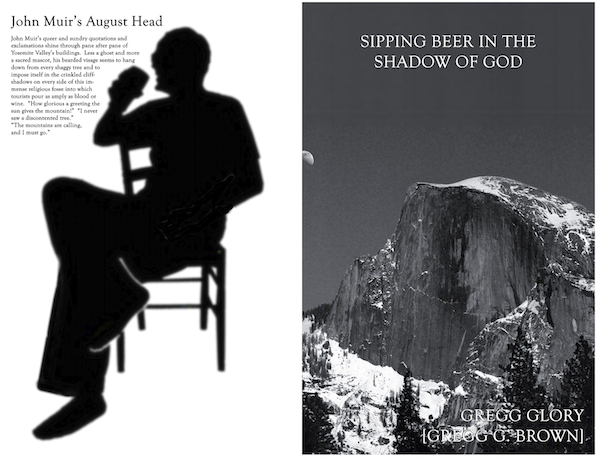
I’ve got the last nail in two new books: “Evil Interludes,” a compelling, fast-paced novel about a poet, Charles Baudelaire, author of the impeccable and fascinating “Flowers of Evil.”. I’ll post the titles of some good books about Baudelaire, many of which I mined for inspiration, along with my visit to an absinthe bar in San Francisco. The other book is a Cali travel journal interspersed with many prose poems called “Sipping Beer in the Shadow of God.” A big part of the journey for me was to see Yosemite again, and to attempt to get down some of the feelings that the place inspires. I have only scratched the surface with my nib.

My next project is a contemporary novel set in the New Jersey beach area around Long Branch and Asbury Park. I am avidly collecting lively anecdotes. Please share some in the comments, or by email. Thanks in advance.

Aug 172011
 

John Muir’s queer and sundry quotations and exclamations shine through pane after pane of Yosemite Valley’s buildings. Less a ghost and more of a sacred mascot, his bearded visage seems to hang down from every shaggy tree and to impose itself in the crinkled cliff-shadows on every side of this immense religious fosse into which tourists pour as amply as blood or wine. “How glorious a greeting the sun gives the mountain!” “I never saw a discontented tree.” “The mountains are calling, and I must go.”

Aug 172011
 

Poetry is like a Dear John letter or your baby’s first word–more is being said than you can understand all at once. Thus it was on my early Spring vacation to a furiously, fragrantly blossoming California, and especially during my visit to famed Yosemite–I was beautifully confused. In Yosemite the strange experience of grandeur is evoked, perhaps for the first time, and this new territory takes some time to be mapped and civilized into the acknowledged borders of our being.

In Yosemite, you can see God’s thumbprint on His creation, the signature of an artist who has otherwise removed himself from his work. But in Yosemite, His grandeur is too manifest, too manly, too vividly veridically vibrant, to remain unacknowledged. And while I was on vacation, sipping beer in the shadow of God, as it were, I began to have a feeling for the identity behind the whorls of that triumphant thumbprint.

I walked from whorl to whorl while Spring broke from the earth in blossom after blossom.