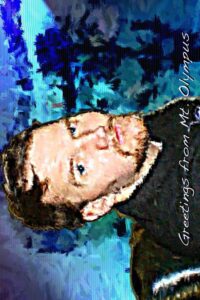
Gregg Glory [Gregg G. Brown]

Gregg Glory [ Gregg G. Brown ] has devoted his life to poetry since happening across a haiku by Moritake, to wit: Leaves / float back up to the branch-- / Ah! butterflies. He runs the micro-publishing house BLAST PRESS, which has published over two dozen authors in the past 25 years. Named in honor of the wild Vorticist venture by Ezra Pound and Wyndham Lewis, BLAST PRESS is forward-looking and very opinionated. He still composes poems on his departed father's clipboard, which he's had since High School.

Oct 262012
 

Reading at the Telephone Bar, NYC, March 6th, 2006 [Banquet and Ascent to be read aloud.]

Tonight’s selection will be two poems of opposite tenor. They tell weird interior tales of consciousness stretched to the uttermost. The references beyond the dome of one soul’s feelings are erudite, scattershot. The thread of the feeling must be noticed, and followed, for these experiments in lyrical insistence to work. Once the thread has been caught, and pulled tight between you and me, here in this room, tonight, together we may strike a chord and hear the heavenly music which is always part of poetry’s supposing.

The first poem, “Banquet,” is the dark, devilish core of the exploded poet. A withering inward glance at the toothless uselessness of poetry. How, when the thread’s not grasped, or when the poet in too hot self-contemplation incinerates the thread before it can be grasped—only the drama of the pyre can satisfy. As when Hamlet, at the close of his trials, drowns the disaster with a refreshing blood-bath. This is how a failure to communicate must end.

The second poem is, instead, a “loaded ode to limitlessness and light.” It has some beatific banter, and some instructive couplets. This is what may arise, phoenixlike, from the auto-da-fe of the first poem. There are longish passages of scenery; the inner feeling has suffused the world in its hopeful glow. The goal of universal love is presented as a given, and the world itself must be the context for that love, today as every day. The soulful voice in the second poem, “Ascent,” seeks to incite a response to the poet’s coo and call. Good luck to us all.

BANQUET
[Available elsewhere on this site]

ASCENT
[Available elsewhere on this site]

THE CURSE OF THE GILDED LILY (AFTER-HOURS)

The reading at The Telephone Bar was a blazing success. It’s no exaggeration to say that I was smashed; I mean, that I was a smash. There’s something about poetry reading events that ignite all the ambition and envy in my soul. Although, ambition and rivalry is nearer the mark. I don’t really feel a negative envy of the other readers. I enjoy their soarings and homilies.

But I do feel a bit left out—seated on the curb as the parade rages on. Harold, the MC of the evening, walleyed and tall in his vintage red sweater, said I’d’ve fit right into Mardi Grais (from which he’d recently returned), and promptly furnished the fireplace with the remnants of my reader’s notes. The goldenrod pages flared a moment and then joined the eternal ashes in the grate.

Somehow, even when people dig what I do, invitations to participate, or gestures of connection, rarely follow the brief fellow-feeling. It was quite unusual for Julie Androshick to ask me up to New York to be a featured reader after listening together to a previous poetry event which she had hosted in the toasty backroom. Most people seem to think that I’m already some kind of success, or that I’ve got “my own thing” going on. That happened even in college, when by definition every writer’s just a callow hack full of egocentrically tender self-regard. My professors thought I didn’t need or want any encouragement or too- close guidance or helpful hints simply because of the radiant bliss I experienced in poetry’s presence. I’m the snagged and angry Daffy Duck, but come off as the brazenly bouncy Bugs.

It might just be that because I enjoy myself so immensely and intensely at these outings that people empurple with a wry shyness—almost as if I’d find them out as fakes or dime-store swamis. I’m always holding myself back, way back, yet am full of a very visible, if not risible, “mire and spark.” I’m going to call this the curse of the gilded lily. Too much shine to actually be divine.

But, unlike the Music Man with his biblical tarrada-tant-ta, I have not found a way to turn my spurious shine to good effect. Oh, poetry’s just not about hosing the wogs in Iowa for a sheckle. (Not anymore, eh Homer?) It’s all about sifting the shiftless from the shineola; those moments of drifting like a thought, a golden straw flitting down from the haypile.

If there’s one thing I’m not, it’s a success. 1200 rejections in a single year bear pop-eyed witness to that. Weary years of wringing words from turds have taken me precisely as far as I could walk in a desert unaided and unwatered. No phoenix will rear and arise here, only more of my alienated longing for beauty will occur.

I’d love for my words to wend their way somewhere other than to the fiery pit; to sigh a sonnet from a teleprompter, or band-aid my hands from book-signing injuries. Anything that would extend, enhance, or deepen those solid moments of eye-to-eye embarrassment that I live for. But those I meet who enjoy a buoyant success, only offer me their scorn and condescension. Ah, yes, it’s the back of the hand for me—and you, too, my readers—and then the lily’s in the wastebin.

The heat in the room was more oppressive than a Swedish sauna. It was Hell, with mittens. Women with their wonderful slopey breasts were in evidence, and I was a hit with the geriatric set. Those soonest to die love the poets best.

Signing off,
Prof. Harold Hill
March 7th, 2006

Oct 262012
 

Memories of the Brighton Bar poetry night.

I arrived with a rose and left with a “Fuck you, Glory.”

Back in the old Thunderbird days, when we’d wangled a reading at the hole-in-the-wall on Main St. in Asbury Park, I would bring in a bale of roses for the poets, and a satchel of water-pistols for the audience. It seemed to me to be an unambiguous echo of how events usually unfolded. Purveyors of beauty were skewered, mocked and wetted. The audience eventually had the roses thrown at it by the poets–their only act of self-defense.

Tonight, at the Brighton, same thing. Only this time, the whole of the audience were poets. And it was as an audience member that I was selected and skewered on the communal kebab.

Now, this venue, and its master of ceremonies, Jacko Monahan, have their own tradition. The compact between chorus and Oedipus is a pleasingly peculiar institution that the blue coats of new talent annoyingly intervene to emancipate into a world of decorous dullness every few months. The previous month, a new cadre of wordsmiths had arrived, cliquish and wicked, from the slam poetry circuit…. Where all is revealed by the poet ransacking her real life–all, that is, except her own prejudices and preconceptions. Oh what I wouldn’t give for one of these menstrual mantras or prick proclamations to begin with a self-withering “I am a bigot!”

But, back to the Brighton’s traditions. It really is more like a rabble of groundlings than anything else. And a passionate rabble at that. “What do you stand for?” might be a typical opening line in the free exchange of ideas and Jack Daniels. “What’s it to ya?” might be a typical rejoinder. And then, what fireworks! People would reference lines they had heard recited that night, or obscure passages of Coleridgean Errata with equal ease. And always, always, with a passionate engagement. Some had a certitude of their divine rightness, while others had a more questioning and questing attitude in their searching conversation. What a lively time!

To those unused to this energetic exchange, such freedom seemed like an assault on their preciously prepared postures. And, looking back, perhaps it was. You had to really have some conviction behind your posture to pull it off; if you were instead using your posture to support or protect yourself from contact, scrutiny, or understanding–watch out! Audience members would often remark on a poem-in-progress as it was being delivered from the stage. These remarks often constituted part of a theme or meme that had been developing from some incident of the evening, creating a cri de coeur of the tribe, a communal poem of rudeness, rarity, and fun.

I am myself, I will admit, one such voice fluttering out of the dark toward the dawning of a conversation, a new co- created moment in the stage halogen’s jarring white, rather than simply be the victim of a whimping, limping delivery of a diatribe from the unstormed castle of the footlights. In fact, the only accurate award I have ever received was at last season’s “Anti-Awards Show Show,” curated by Professor Vile, but voted on by all, where I tied the artist, guitar-smasher punk, and bon vivant Ken Bastard for “Best Heckler.”

A new, tall poet was on stage, confessing her sins and damning her lovers. She’d been a few times now to the rugged arena of the Brighton, and had been liberally dosed (or douched), certainly by me, with the God-awful gospel of “the truth as I see it.” Her poems, to me, have such a great zing of poetic perspective, deep sensibility and feeling… occurring within the amusement park of standard confessional / slam poetry. She was using this format to get to and explore, or reveal a vein of sincere poetic feeling–pure feeling without judgment or conclusion. Posture had become its own parable in the best of her work. I felt encouraged to contribute from my paltry barstool.

What exactly I said, at this remove in time and space, only an Einstein could reconstruct. But my fellow campaigners in the crowded night squawked, I feel sure, their meaty amusement. As when young, dovey Rachel Weeks, no more than two, bunched her face up like a fist and pointed imperiously her out-flung finger and reprimanded her father with a hearty “Turkey you, Daddy,” the poetess on stage, a Jessie Smith (who’s grainy seaside wedding I just attended a few weeks ago (ten years on from this incident)), squinted out into the dark of the audience with a chuckling, but firm, “Fuck you, Glory.” And so we see that there is no end to our yearning to be let alone, just as there is no beginning to defiance besides birth, into which we are all “untimely ripped”–debouched ineluctably into this circus of our struggles.

Oct 262012
 
Chained to redemption by the individuality of each human consciousness

Slaves of Glory

The very astonishing hour has come.
The very astonishing hour indeed!
Green Heinekins, jade brain and rose-coral vodkas 
--Exhausted! In one final, fantastic evening.


Hosannahs invade the empty windows,
spurs of blacks, mysterious
 
As the tender invitation of the body.


Bright, alcoholic after-haloes sift
               Timid ash upon stale, upraised lips.


Sobriety has entered us
As mourners enter a white church.
 
Enough of this pathetic quietness!
This simpering, dog-like wish for 'temperament'
The madness of faces full of 'sound judgement.'
I forgive all disasters, all accomplishments,
Every disguise that announces 'I am finished!'
Choking its inhabitant as a mirror chokes beauty.
Songs of sporadic intensity, wicked verses,
The poem of flayed skin, blind eyesight
Mutes imagining laughter, I forgive you!
 
          Pathetic quiet!
Bring tympans, wild sibilants,
           Drunken elephants of sound, mists,
the harsh clangour of brass.
 
New eyes, new hearts, new senses!
Bring a speech of bloods, the invention of Angels! 
Why was one ever afraid of waking?
Eh! a little daydream I had in the haypile.
 
But now the new era has arrived--this moment! 
Let us revenge the sky for an hour!
 
Let us run out, muds of new births upon us,
And seize in hands of ice the very flowing waters--
--Dreams of incorporeal perfection!
 
Dawn leaves splinter in my eye 
Enacting the death of Satan.
 
Vertiginousness in the closet!
 
Very astonishing!

It is the witching hour in this poem of rebirth. This is the “very astonishing hour” when anything can happen, and does. There’s an echo here of Goethe’s Walpurgisnacht (“one final, fantastic evening”). There’s a Satanic suggestiveness in the darkness of the scene, and in the exhaustion of ribald modes of stimulation. The Bacchanalian means of inspiration and change of one’s mental state through alcohol have ended… and yet the desire for change, for growth, for experience continues, if anything, more intensely. The soul searches for new forms of re-invention, new means of exultation; for connection with the “infinite” as Baudelaire would say.

A stanza break occurs at the moment of “giving up,” when the exhaustion of the previous celebrations and vineyard methods of ecstatic outreach are at their peak. A moment of silent nothingness… the death of all mystic oneness with that which “makes the world go round.” And then….

“Hosannahs invade the empty windows”–the windows are empty, the mystic connection is dead, the speaker is in a world where what surrounds him is the void; there is no ultimate referent to anchor his searching. “Hosannahs” is used in both the Jewish and Christian sense. In the Jewish sense as a plea to God and to the more modern, pagan Beyond to “save me now” from this state of exhausted disconnection. And in the Christian sense of praise and excitement that “the One,” the Messiah, has come–as is evidenced in the rest of the poem. “Hosannahs” sit at the fulcrum of the poem. But this second sense of “Hosannahs” hasn’t fully dawned on the speaker yet. We are to accompany the speaker on this journey to ecstasy. Right now there is a wary sense that something new has entered his consciousness, something not necessarily easily distinguished from the “blackness” of the windows looking out on nothing. There is only a dawning sense that some alchemical change is starting to occur–and this new beginning, after the death of the old forms of ecstatic insight, is “as tender as the invitation of the body.” This is a parallel to God’s being made flesh in Jesus. This is as curious and crazy a newness as when we ourselves first arrived to experience life as babies. Everything is unknown and seems unknowable.

The death of the old way to ecstasy, the “timid ash” of Bacchanalia, is taken in faith of its being about to be renewed, with a teasing reference to the “new life” of the Catholic communion; but here, instead of crackers transubstantiated into the flesh of Christ and symbolic of a “new life in Christ,” we have phoenix-like ashes, the sour mash taste that sticks to the mouth after a weekend bender. Is the speaker being ironic? The speaker at this point registers the “death” of the old way, and joins that mourning in sobriety. It is a painful experience of grief, to give up the known to embrace what may be–for all the speaker knows–nothingness itself.

Then, with the irritable brashness of a new convert, the whole parade of human life comes in for a sober reassessment. The speaker will no longer be silent about the variety and extent of falseness apparent in our communal human life–everything from status-symbols (“accomplishments”) to our private vanity (“as a mirror chokes beauty”) become obstacles to the new life, the rebirth, of the individual. Although he doesn’t know what this new life might yet entail (the empty windows), he knows that the old chemical passage to heaven is done, and that the status quo does not provide any enlightenment on its own. This is the psychological atmosphere of all destructive revolutions, and “the people” are ripe to be ripped-off by any huckster passing off a latest-edition paradigm shift. The “pathetic quiet” of the status quo is condemned not once, but twice, as if merely raising a hullabaloo will help forward the project of rebirth that is at hand. “Make a joyful noise!” goes the old psalm; but there, the reason for joy has already made itself evident through a process of revelation–either via Moses com in’ down the mountain, or by Jesus being crucified to the skies and then defeating death in his own body. Here there is no such revelation, only the ground-clearing destruction of the status quo.

As if “tympans [and] wild sibilants” aren’t enough, the speaker calls for metaphorically questionable “drunken elephants of sound.” What is being demonstrated in this poem is the very process, the very moment of revelation itself. Every truth,”every disguise that announces ‘I am finished!’,” has been abandoned or destroyed in a process as madly methodical as Hamlet’s ripping through excuses for inaction and his stabs at attempting to get to the truth of the past through various rhetorical stances and the linguistic investigations of his one-off soliloquies. Deliriously radical in approach and existential in stance, this is the antithesis of a poetry of string emotions “recollected in tranquility” as such as Wordsworth recommends. This poetry has more in common with the confessional poetry of the 1960s, perhaps the reportage of a drug trip, or the witnessing of a baptist tent revival than with traditional poetic forms and resources. Intent, intensity, and the willingness to report from the edges of self-knowledge, seemingly without any guess as to where this reporting will lead either the reader or the speaker all combine to give this piece an almost tragic tension.

The danger of such a far-out technique, of course, is the arousal of frustration in the reader. Religious conversions have a set script and goal that the entire community of believers is deeply aware of; Greek tragedy tells stories similarly well-known, although the catharsis is tragic rather than ecstatic in nature. “Slave of Glory” leaves us in doubt as to what the final outcome will be. Are we to become mystically empowered by “new eyes, new hearts, new senses”, or is this attempt to synthesize a fresh religion on the fly going to leave us as disastered as Icarus? I believe it is this very uncertainty, and this willingness to explore the edges of experience and insight anyway that this poem is hoping to make explicit through its uncertain technique. It has something in common with jazz, but the original melody itself is improvised; there is no variation on a theme here–all themes are consigned to the wood-chipper of history, failed ecstasies, old golden moments no longer valid. As ambitious as this project sounds–the founding of a new religion or new mode of consciousness–the speaker seems, once roused to the task, to take it in steady stride:

Why was one ever afraid of waking?
Eh! a little daydream I had in the hay pile.

Then a series of fantastic, indeed hardly creditable actions and incitements are listed, ice hands holding water, revenging the sky, all contained under the oxymoronic rubric of embodying “dreams of incorporeal perfection.” Indeed the tension of ambition vs. realization reaches its epic height (at least, as codified in the Judeo-Christian tradition) when the speaker claims to see his new world “enacting the death of Satan.” This is the apotheosis! And to think, only a few moments ago, the speaker had just awakened with a cracking hangover! Has Time itself been put to the sword? Since, however, we are in the linguistic tangle of a poem, the reader may feel prompted to recall Wallace Stevens’ observation that “the death of Satan was a tragedy for the Imagination.” With this cautionary note sub-consciously struck, can irony be far behind? How are we to take the next, deeply ambivalent (ecstatic? spastic?), stanza:

Vertiginousness in the closet!

There’s no telling. The poet is keeping his cards guardedly close. Does your life satisfy without the blast and lambast of a new religion? Are you interested in defying the cage of bones and memories that define your personhood? What do you think you want, and what do you really want? Is desire itself a fool’s mission? You’ll get as many definitive answers here as you will re-reading The Tempest a trillion times. What is left to say when our limitedness meets with the infinite?

Very astonishing!

Oct 142012
 

An exploratory twirl across a precarious bridge of words in “The Suspension”

The Suspension

bridge being
by its nature
incomplete

at either end
without anchors
heavily laden

and the wide
context of connection
of place

to place
like a man webbed
to his life

birth to death
pegged feeling
traffic

tickle across him
as he sways daily
going nowhere--

Watch the wind
now playfully
wake it

singing!

The punctuation of a pause. An incentive in the incompleteness of a phrase broken across the spine of several lines of verse. Like the tense energy of a bullwhip that gathers to a crisp crack that then echoes in the listeners’ ears, “The Suspension” attempts this trick of suave timing and intention. The effect is to leave a suggestion of multiple meanings and insinuations in each line far beyond the mere sketch that the words themselves provide. Laid out and read as a simple pair if sentences, there’s not a whole lot of intensity in the language. But, strung across the intervaled frets of the line breaks, the language gains enough tension to be play many different tunes without breaking the basic sense of the piece.

Read aloud sensitively, the voice is pulled toward a monotone. The monotone is a way of testing each word by its own merits, without prejudice. Each word adds its plink to the melody beyond (or absent) any assumed speaker’s intentions; like a tune clawed from a Japanese samisen, the spirit of the listener finds itself eerily manifesting in the perfected intervals between each line, word, and syllable. This method of versification trends toward the use of monosyllabic word choices since that lets each meaning-and-sound unit most easily have its maximum impact of implication.

In this poem, the tension of multiple meanings and implications begins right in the title. Let’s speed through the lines with some initial possibilities before we consider how all of these multiple meanings and some of the sound values add up to the sort of sculpture-in-motion of one of Calder’s merry mobiles–a stiffened, crafted and finished shape that still can change is outline even though the observer keeps his mind “still like the hummingbird.”

The Suspension(motion tensed to stillness; a paused act; implicit indecision; being let go or released from one’s usual work or task;)

bridge being(the physical object of the poem surpassingly introduced, the bridge; essence of the object, or being, is connection; connection between two of what, though; connection itself as a form of stasis; oxymoron of this stasis, which pulls the meaning in two directions at once; a suspension bridge is the lightest and most aerial kind of bridge, a tightrope across an abyss;)

by its nature(both naturally and in the outward manifestation of its interiority;)

incomplete(pulling away from the implied completeness or fullness of ‘nature’ in previous line; emphasized by its placement at the end of the stanza; having in air like the suspension bridge itself, a natural manifestation of the oxymoron;)

at either end(changes the focus from the bridge to its end-points; neither end is itself the focus, which keeps suspended feeling going; question arises: how exactly is it ‘incomplete / at either end’; the eye can look only at one end at a time, and so shifts back and forth; the mobile is twirling;)

without anchors(the nature of the incompleteness is modified: anchors remove it, complete the connecting nature of the bridge; raises the contemplation of an anchorless bridge; would it be like a kite let go in a storm; would it simply collapse;)

heavily laden(nature of the anchors; the lightness of the bridge requires weight too, like a kite when guided by a fist holding its twine; sense of oppression; loss of freedom; the weight of the past; a burden spiritual or physical;)

and the wide(opening the viewpoint; wideness of river; bringing in the existence of whatever is bridged over; bridge overcomes an obstacle, this is at least implied;)

context of connection(meaning, context, occur only beyond the actual span of the bridge and its anchors; no man is an island; riding the mobile is a game of blind-man’s-bluff; pattern requires perspective;)

of place(the context, albeit in a generalized noun;)

to place(place is doubled, like the anchors; origins and destinations are definite, but is the bridge equally real;)

like a man webbed(major simile of the poem is introduced: the bridge is like a man, man is like a bridge; continuation of slight anthropomorphization of “heavily laden”; “webbed” is an unusual word choice, the only metaphor in the poem; stringiness of suspension bridge referenced; man and bridge are tied down, laden; whether spider or fly remains unclear;)

to his life(life is the place of human context; destinations;)

birth to death(place becomes time; length of a man’s life is the width of his context;)

pegged feeling(subjective aspect of connection emphasized; burden underlined; suggestion of crucifixion, sacrifice;)

traffic(quick switch back the literal context of the bridge; many things, many thoughts, many feelings travel over the bridge of a man’s burdensome existence; once an electronic circuit is complete, information flows;)

tickle across him(quick switch back to the subjective context; “tickle” implies it may not all be suffering; annoyance of tickling; implied laughter too;)

as he sways daily(indecision of being pegged, webbed between obligations, burdens, anchors)

going nowhere–(man’s life, like bridge, although a means of connect is itself inherently directionless; induced oxymoronic meditative state; threat of meaninglessness; dash emphasizes stoppage;)

Watch the wind(first new clause, capitalized for emphasis; the invisibility of the wind is a hidden context of the suspension bridge, the medium of its swaying; like time is man’s invisible medium of his existence;)

now playfully(return to lightness of “tickle”; context of bridge is beyond bridge’s, or man’s control;)

wake it(invasiveness of windy context liberates the bridge from its burdens; no “patient etherized upon a table,” the bridge, the man, is conscious in his suffering, the necessities of his connections;)

singing!(wires of the suspension bridge hum and sing in the playful wind; reminiscent of Coleridge’s Aeolian Harp poem, which was a metaphor for the soul; trapped between places and contexts, weighted at both ends, run across by purposeful others, still expression, freedom, patterns of meaning and feeling are possible; )

Oct 022012
 
The Ever-Arriving River

How do we know we have arrived?

No gate blows open, no trumpet swings wide
Giving boogie-oogie oogie-boogie to the countryside.
Our horses must feed on grass, or perish.
So, too, our souls.  Having gone down the long defiles
All night, in a night that is not sure of ending,
Our souls paw their bellies and howl.
Even a ghost craves ghostly sustenance.

Have we arrived then, when midnight creaks
And starved souls howl at the wolvish moon?
Or must we still, in our hunger, kneel and pray?
Must a glittering track shiver in the sleepy pines
For the last mile shimmied on our knees?
Bend at that track, and drink with tragic hands,
With hands encased in silver to their wrists.

Drink and drink;  drink deep, O traveler--
Tomorrow we must find this river again.

The themes of this poem can be said to be paradise, pain, and persistence.

The first line of the poem immediately creates the context and then throws it into question.

How do we know we have arrived?

In the title it is the river that is arriving. In the first line the question is about our arriving. There is some confusion between whether it is the river arriving or us who are arriving. What is the relationship between these two arrivals?

What does arriving mean anyway? If the river is ever-arriving how do we know we’ve ever gotten anywhere? If we don’t know that we’ve arrived somewhere what is the problem that creates? These are the sorts of questions that are created by the tension between the title and the first line of the poem.

The reader and the narrator of the poem both seek reassurance on this point. The second stanza begins with a frustration of that seeking reassurance. Traditional signs of arrival, signs of having completed your journey, are denied the speaker and the reader both. “No gate blows open.”

“No trumpet swings wide,” the horn of Gabriel, the official welcoming at the gates of heaven, is absent from the countryside. There is no sound of welcome available to the traveler. Indeed the silence seems to mock the reader and the seeker. The “oogie-boogie” of 1940s swing music is unavailable to the traveler, and hides another pun in the poem only a footnote can provide.

This lack of welcome, this lack of acknowledgment, this lack of arrival, then create an intolerable tension in the poem. We are not only mocked, we are in peril. “Our horses must feed on grass, or perish.” The horses, representative of purposeful onward motion, must find some sustenance or die. Our sense of arrival is frustrated. We must seek a way to go forward even one more step in this unwelcoming countryside. The analogy to the spiritual context is made explicit in the first half of the next line. Our souls are directly compared to the horses which carry us onward. The long night of the soul is vividly evoked as “the long defiles / all night.”

The spiritual context of the seeking, the lust for Paradise, is underlined in the last line of the stanza “even a ghost craves ghostly sustenance.” So here we are. We are suffering, we are seeking. When will we arrive at this fabled “ever-arriving” river? The ever-arriving nature of the river is reminiscent of Heraclitus’s observation that one may never step into the same river twice. Will the river be the place of our renewal, our welcoming? Is it truly to be the destination that we are seeking?

The hope is set up in the poem that indeed the river will be the paradise our souls are craving. But on what sustenance Olar soul survive in the meantime? Is our desire for paradise itself the sustenance we seek? The third stanza asks these very questions. The conditions of “arrival” are mixed up with the conditions of seeking, the “starved” nature of the spiritual quest is itself considered a sign of arriving someplace. Our hunger for spiritual fulfillment has lifted us out of the ordinary daily context of our lives. We’re no longer simply mortal. We are mortal and spiritual creatures, locked into a quest. This seems a bit medieval and some ways. Like Parsifal with his vision of the Grail, we are beset with a vision of an overflowing, ever-arriving river. Our thirst is great in the darkness of our long spiritual night.

But mere spiritual hunger, mere spiritual seeking, are not enough to fulfill the requirements of arrival. We must still “in our hunger, Neal and pray.” To wish for spiritual fulfillment to seek the river is not enough. We must, even without the grass that are horses require, even without finding anything yet, we must “kneel and pray.” We must, even in the midst of our suffering, be grateful. But this is jumping the gun (or the gate) a bit here. First the poet ratchets up the tension of the seeker’s dilemma a few more notches. The pervasive use of the the communal perspective, “our horses,” “our souls,” draws the reader into alignment with the speaker’s quest. It is not dissimilar to the old preacher’s trick of addressing his disparate congregation confidently as a single community, a united entity, small before the greatness of The Lord.

In the desperation and tension created by the prolonged absence of paradise or the goal to which the traveler is headed, a vision of this final destination appears. In the middle of the woods, in the middle of the countryside a “glittering track” appears uncertainly in the moonlight. Is this the long-awaited “ever-arriving river”? Maybe it is and maybe it isn’t. But our approach to it (whether it is real or imagined only among the “sleepy pines”) must be prayerfully attempted; we must move forward the “last mile” on our knees. But even here, even in extremis, the mocking humorousness of the situation is not neglected by the poet; this last mile, oogie-boogie style, is “shimmied on our knees.” It seems that we are to chuckle at ourselves in our spiritual seeking, our thirst to arrive. Perhaps there is some nobility in such a sly acknowledgement of our perpetual “shortcomings.”

This uncertainty of our arrival–emphasized from the first line of the poem–is no doubt why we are instructed to drink with “tragic hands.” And then there is the brilliant image of the hands, wet with this very ambivalent arrival, after our midnight creeping, after the anguish of our hungry souls “howling” for sustenance, “encased in silver to their wrists.” Our desire has brought us here, has manacled us to this destiny of seeking. Even in the very act of fulfillment there is to be no satiation; we are locked into a cycle of spiritual seeking. It is a rather grim image of that meditation many traditions label a spiritual practice or discipline.

But what other choice does the howling soul have? Given the poverty of our spiritual circumstances, given the hunger for arrival, we can only continue to seek. But now that we, with sufficient gratitude and desperation, have arrived at this temporary river, we should drink. Tomorrow we may seek, but tonight we drink!

Drink and drink; drink deep, O traveler–
Tomorrow we must find this river again.

Gregg Glory
[Gregg G. Brown]
Oct. 1, 2012

Sep 242012
 
On Being a Human Bean

On Being a Human Bean

On Being a Human Bean,
Or, why Jessica Smith should finish her book My Sweet Demise
A wedding present

When, in the course of childhood and the berating onset of adolescence, an individual human bean becomes gradually, and then gratingly, aware of her self as distinct from other selves–a new necessity is born.

Each human bean is, by definition of being separately countable in the big jellybean jar of humanity, unique. This is fine, as far as it goes, and the dim sense of having one’s own color and taste while rubbing against the sweet mass of humanity is often enough for most human beans. They require no more expression or self-justification than an Oprah-endorsed self-help book and a new pair of slinky sandals can provide.

But for some human beans, simply being accounted for in the crush, one member of the “How many jellybeans are in the jar?” contest, is not enough. It is not satisfying; the tailored undershirt of peer-pressure, for these human beans, is an itchy fit. A noticeable discomfort grows behind their eyes; they survey their life and the lives of those around them and try to figure out why they no longer feel like they fit in. Why is life in the jellybean jar no longer enough?

How many jellybeans are in the jar?

How many jellybeans are in the jar?

Were they wiggled too long against the glass of the jellybean jar, giving them visions of tastier horizons?

Were they accidentally isolated until their thoughts became loud as a drumbeat in their ears?

Were they shunned and spurned for being too tall, too short, too smart, too something?

They may ask their parents and siblings for an answer. Most likely they will get responses ranging from “It’s just a phase” to “Stop whining for attention–geez!”

And so our individual human bean is left to her own resources. Now, all the while she is living and loving and riding her bike to the park, she is also thinking about the why of her differentness. She is imagining answers for her questions; she is watching the edges of the jellybean jar for an escape hatch, some hidden way out that will let her see things more clearly, more cleanly. She watches herself thinking and feels herself feeling.

Maybe I am a Mexican jumping bean! She postulates.

A Mexican Jumpin Bean

A Mexican Jumpin Bean

Maybe I am a pebble painted pink and mixed in with these beans, she wonders.

Maybe I am really a gumball with a bend in my middle, she considers.

But none of these possibilities is the answer. She is just a human bean, just like all the other human beans. And yet…. Her sense of being different just won’t go away. And then she discovers that, as painful and problematic as feeling different can be, she doesn’t want her differentness to go away. She wants to be just as different as she is. Heck, she smiles, I should write down just how different, how special I truly am. And I should do it in my own special way.

She wants to be herself, and nobody else. And she wants to share that self with everybody else. Her color, her flavor; her own sweet demise–from one human bean to another.

My Story by a Human Bean

My Story by a Human Bean

Aug 182012
 

From the “Soiree” series. Short essays incited by the Soiree de Poesie Francaise held monthly at the Cranford TeaSpot in Cranford, NJ with my careful co-host Carrie Pedersen Hudak.

Paul Verlaine

Paul Verlaine

The third was staring at his glass from out abysmal pain;
With tears his eyes were bitten in beneath his bulbous brain.
“Who is the sodden wretch?” I said. They told me: “Paul Verlaine.”
~~Robt. Service, Gods in the Gutter
http://poetry.poetryx.com/poems/3907/

Here lived and died a man of towering passions. All of his wisdom is the poverty of passion. To be blown about by the winds of his passion taught him all of life that he would ever know. His reaction to these buffets and blows of interior turmoil was to write exquisitely disciplined poetry. His poetry could contain and describe his wild passion; or, if not describe, indicate and evoke those passions in his readers. For, of course, Verlaine was one of the first masters and principle proponents of the idea that vagueness and nuance (or “the apprehension of reality though sensation” as Philip Stephan puts it more precisely) is its own value in the creative exercise of language. Naturally, when Verlaine came to write a directive adumbrating his new view of poetics in his justly famous poem “Art Poetique,” one of his first instructions to would-be poets is to “take eloquence and wring its neck!”

When passion is pursued in the mood of passion, and not “recollected in tranquility,” as Wordsworth recommends, special problems–both of validity and precision–arise. To be in the mood of passion is to be a bit intemperate and overblown, yet to represent or evoke that passion is to require the calm precision of the watchmaker squinting willfully at his bench. Perhaps only God could do the thing fully, sending a third of his tripartite self to live and suffer a life of passion, inspiring by his demise and titillating all of the arts for centuries. But if one must pen the poem as well as suffer its inspiration? How is one to do it? Even our man on the cross felt abandoned in such circumstances–and this is Verlaine’s precise starting point.

College DJs who play the loudest music often have a laid-back demeanor that they present between the tracks. Using loudness in amplified music as a rough contemporary equivalent for passion, we can tune in to limitless hours of top-volume hardcore screeds and screams punctuated by a laconically under-caffeinated tween’s wearily somnolent hypnosis-inducing voice. How else can one’s underpowered words bracket the screech of a jet engine? And this is world-weary wispiness that Verlaine often uses to approach his most emotive moments.

Surfers also have a lifestyle approach to their art. You can’t master the enormous energy of a righteous curl, you must surrender to it. And yet, of course, there is a great art in the surrender; a finesse, and a requisite strength. But, and this is the key distinction, one must throw one’s whole being into the task–including one’s habitual attitude toward life, the way you carry yourself in daily tasks. The surfer’s reward for going whole hog, for giving up any other way of life? The ride of their lives! A seemless oneness with the wave, with God.

Images of extreme delicacy are a hallmark of Verlaine’s poetry, and I don’t mind indulging in a few over-the-crest metaphors to make my point regarding his verse. Verlaine may be one of the most difficult poets, besides Mallarme, to translate and keep the emotional meaning of his work intact. This is to his credit, and to Poetry’s eternal glory. I feel that the way his translated poems best resonate is in their referring so deeply to imagined moments of perception, with all the indistinct machinery of subjective consciousness intact. I think of Robert Lowell’s short sweet poem “Myopia,” which perfectly capture’s the time between removing one’s eyeglasses and the onset of sleep as an objective correlative to how Verlaine’s poetic technique operates. But with Verlaine, much vaster ranges of emotion and ranges of subjectivity are handled with this sort of one-off precision. He did find a few sorts of experiences especially effective in his experiments, and one often comes across indistinctly heard music, voices in other rooms, the blurry warbling of a fountain, the smeariness of tears whose origin is unknown even to the weeper.

From the turmoil of his life, he brought forth dreamlets of beauty, remorseful echoes of joys gone by. Verlaine “grabbed for the gusto,” as we might say. And these moments of gusto, of beauty, then left permanent traces in his memory, which he recreates with the delicacy of watercolors and with a careful attention to suggestive detail–allowing the reader’s own imagination to be more fully engaged in the task of re-creation. What had been his private experience becomes your own private experience, since you must bring the details and explicit emotions to the piece that Verlaine creates. He will not profane the pinched heart with an abstract label; he will not narrow the field of his telescope with a name. In this way, his compositions are almost musical, with a suggested theme or setting, and with much of the enjoyment created by being subsequently aroused within the reader. Pornography perhaps achieves this same effect, but with a simple explicitness of imagery and soundtrack–and an equally stereotyped outcome.

Not for Verlaine such paucity of passions! We do, perhaps, feel some effect of being forced to squeak or groan upon command, as if our own feelings are not as great, not as sharply engaged as the author’s are. Too, there is a sense of exhaustion that can set in–not the intellectual exhaustion that happens when reading some brawny-brained poet, or the tiredness of tracing out too-whimsically filleted a plot, having trod from the Caucuses to moon-craters and back again–but an exhaustion at having to experince too deeply our own conjured feelings. With Verlaine, quite uniquely perhaps, there is an emphasis on getting out of the poem what you are able to bring to the poem. I think perhaps his poetry can get us to the irritable sleepiness of a good psychotherapy session; we have glimpsed the cunning crowded whirling of a few of our enmeshed emotional cogs, noted a few revealed connections that we hadn’t been conscious of before, and then, aghast, expressed, and, strictly speaking, satiated at feeling these new revelations, we need to return to our old selves for awhile. The mental incisions must heal and we must reassure ourselves of our old homey surroundings as we yawn and blink.

There are many risks inherent in this strategy of creation. The reader may be too young, naive, or emotionally undeveloped to be able to bring to the poem the sorts of feelings that the poet-surgeon is so delicately attempting to diagnose and evoke. Verlaine’s poems may simply seem weak or vague to such a reader. But Verlaine is too careful a craftsman to allow even the casual reader to dismiss his efforts, which are so very exacting in their forms. A bedpost chiseled by Bernini is not just a bedpost; a slip of the tongue by Freud himself is a fraught affair! The labor of Verlaine’s efforts are obvious even when the effects are ephemeral.

It is this tenacious veracity in the technique that can let even the most vigilant reader relax into a trusted relationship with the innovative tricks that Verlaine is attempting in his verse. He has the strict form of a Parnassian, and the cutting-edge content of a symbolist. Baudelaire first opened these floodgates, and in English the emphasis on vague evocativeness came to a head in the early Yeats. Yeats uses Irish myth and the flitting world of faerie to float the reader to new realms of daydream and emotional meaning. Writers like Verlaine, like the Impressionists in painting and Debussy in music, sought to create new feelings and sensations that did not yet have a name. Whether such a search for new experiences can ever bear true fruit, I cannot say. But even a old saw needs to be re-toothed when it wears dull. Each age seems to have its own “sensibility,” its sense of itself as being different from those who came before, and from those who trail after. Perhaps this is all that may be reasonably said about the matter–the vortex where style and substance intersect.

Jun 242012
 

My new project is to illustrate and notate my old “Rehearsing Repetitions on the Rappahannock.” This is a book I adore, and which no one else really cares for too much–like “The Departed Friend,” which was about my feelings of loss when Jeff Moller stopped being my buddy. I did eventually send a copy to his last known address, but he returned it unopened, just like the Weird Al Yankovich tickets I had sent a few years earlier. It is difficult not to reach the conclusion that it is oneself who is the toxin in such relationships. But I believe that I am not, even so.

I think I am a giving, and even generous, friend. And I see the beauty in beings who are in need, and extend myself, perhaps uninvited, into their world. It is this quality of “uninvited,” I believe, that eventually wears thin. When the subject of my interest and affections grows strong with genuine self-worth (perhaps partly, I egotistically state, from contact with my unflagging approbation of their being), they look back with disapproval at who they so recently were, and exile or dismiss that past. I, as an associate of that past (and an approving and loving associate at that), must be exiled as well. To continue in friendship with me is to acknowledge a continuity between their own old bad self and their current stronger, healthier self.

“Whatever gets you through the night,” is a song that comes to mind. If what gets you there is base betrayal of loyal friendship, well, that is preferable to death–or the death of one’s self-concept (self-conceit?) in any case. Or so, at least, I believe, wanting to forgive rather than forget my old friends and those dear to me who have “moved on.” Even as I sit here, fingers lightly aligned on their home keys, rancorous and angry.

Jun 062012
 

From the “Soiree” series. Short essays incited by the Soiree de Poesie Francaise held monthly at the TeaSpot in Cranford, NJ with my careful co-host Carrie Pedersen Hudak.

Andre Breton

Andre Breton

Please cover your eyes for a moment. Feel your fingers over your eyelids, feel how more profoundly loud my voice has become….

What can one say about surrealism? It is a literary form innovated and defined by Andre Breton. You may already be familiar with the idea of nonsense randomly injected into poems, or the idea of retrieving errant bits of dreams for display, and possibly you have experimented with the discipline of automatic writing, where one writes uninterruptedly for a set period of time without any editorial, story, or lyrical intention. But what I would like to resurrect most in this short note about the contribution of Andre Breton is the overriding sense of *fun* that the surrealist enterprise was both driven by and tried to drive back into life.

For Breton, dreams were an opportunity to snare some of our original, unscripted, individual responses to actually being alive. With eyes shut, with the paws of Morpheus firmly over our daytime sight, dreams open another portion of ourselves to examination. As opposed to Freud (to whose pioneering work the surrealists owed much), who saw in dreams the resolution, re-enactment or re-engagement of a set palette of timeless dramas, traumas, and family situations, the surrealists saw subconscious life as an arena in which we were ourselves without the conscious mediation of society’s rules. We spend most of our lives learning to obey these rules in all their intricacy, forming our characters to exist within the set of behaviors our culture considers acceptable. In dreams, however, we are free to commit murders, rapes, enact heinous revenges and lusts, or dawdle on pink river banks plucking inexhaustible daisies sighing “Love me, love me not.” We can engage in the sort of endless lolly-gagging that neither society nor we ourselves would allow in our day-lit existences.

Surrealists–Breton foremost among them–sought ways to bring this liberated feeling of the dream realm into our daily and artistic lives. Automatic writing, dream journals, and other tactics were employed to get us closer to the sense of expansive liberation and terror of dreaming and farther away from our self-definitions and all-too-self-conscious self-definitions. And one of the key feelings that accompanies liberation is an expanded sense of *fun* and hilarity. “I’m doing this because I can, and not because I must. What fun!” Joy, games, the innocence of childlike guesswork and play are all key components in the surrealist enterprise.

And this is where surrealism most closely resembles its immediate artistic ancestor, Dada. The whole world had been mapped, and, with WWI, blown to pieces. Dada emerged from the energy of *rejection* of the status quo that had brought the Western world to the massacre of total war. But even in the midst of this overwhelming demolition, the self was still throwing out its imperative nonsense in millions of unbounded dreams each evening. Some twenty-five percent of the globe is living in a dream as we gather here. Who is to say that those dream heroes, dream agonies and joys are not more ultimate than our own repetitive waking obsessions? As smoke curls from a pipe, our dreams, thrown into the light, reveal the hidden currents of the atmosphere that surrounds us. It is the old tale of the fish not seeing the stream that sustains him. Surrealism has a more improvisational and eternal character than Dada. It is rooted in each individual’s original confrontation with Life. Whether that confrontation with life is ridiculous or daring none can say–it is itself, bound to no ritual past or completed self-conception. It exists in pure, ecstatic *discovery*. What new continents will unfurl in the explorer’s wake?

Being open to our unknown selves, to mystery as the essence of our existence and not some unsolved corner of the puzzle of what it is to be–is to live in creativity. Every rule is transformed from a necessity discovered by some dire trial-and-error experiment mired in accumulated history to the fun and temporary rules of a game–a game of peek-a-boo we play with the mystery of which we are composed. With surrealism, we swim constantly at the edges of our boundaries–hop-scotching happily among our myriad aspects.

I do think that Breton’s many manifestoes of surrealism should be seen in this light: as invitations to play *this* game with him, and not some other game. To enunciate such a plethora of principles and “rules” is its own sort of wry in-joke that challenges the prejudices and pre-conceptions of its own previous iteration. As the classic tune of the American West sung by the out-sized folklore character Pecos Bill playfully proclaims: “Don’t fence me in!”

2/19/12
Gregg Glory
[Gregg G. Brown]

Jun 052012
 

From the “Soiree” series.  Short essays incited by the Soiree de Poesie Francaise held monthly at the Cranford TeaSpot in Cranford, NJ  with my careful co-host Carrie Pedersen Hudak.

Victor Hugo

Victor Hugo

The courage and freedom to imagine one’s society contains within it the capacity to re-imagine it. This is the deep seed of all revolutions. A renewal or re-imagining of conscience is what every change in the social order requires. The industrial revolution came upon Europe in Hugo’s era, calling forth the equally large energies of individual artistic innovation. Reality was changing–the imagination needed to change as well.

Hugo invented the “realistic” or “naturalistic” novel–a form of artistic expression as broad and multifarious as the new industrial reality confronting the France of his day. And this form, being reflective of reality (a mimesis, as the ancient Greeks would say) could keep pace with the breakneck changes of his Victorian era. Indeed, so effective was Hugo’s artistic solution to confronting his contemporary reality that a whole school of naturalistic novelists grew up in Hugo’s gargantuan shadow.

But it is Hugo’s poetry, acclaimed in his day by a poetry-hungry audience, that shows the fire of his spirit and the philosophical feeling that impelled his will to contribute to his society through literature. In his poetry, besides heroic and harrowing story-poems, we get some extended philosophical “meditations.” I wouldn’t put them anywhere other than in the category of “meditations” because it is the subjective feelings aroused by his philosophical conjectures that are the real focus of the poems.

Hugo imagines his individual mentality adrift in an infinite abyss of space–making his self infinitely tiny and insignificant in comparison. This is a philosophical correspondence with the religious notion of humility before the awful throne of God. And yet, at the same time, Hugo imagines–feels–that all the threads of thought and feeling that go zinging about in this infinite abyss actually meet at the crossroads of his heart and his head. Hugo is the humble egoist of infinite space!

In human terms, Hugo is a nothing–just like the rest of humanity before the infinite–and, therefore, he can use his private philosophical feelings as a basis to create universal art. His ambition springs from his humility before the vast, new, roiling experience of Life with a capital L. Hugo is nothing–but, we all are nothing–therefore Hugo can speak for all of us! This is a paradox made clearest in his philosophical poetry.

How much more marvelous a solution to the overwhelming dilemma of the Industrial Age. Instead of becoming an inward-looking miniaturist of his private feelings, Hugo leverages our shared insignificance before the infinite to create some of the largest, broadest, most weepingly human art since Shakespeare.

Jun 022012
 

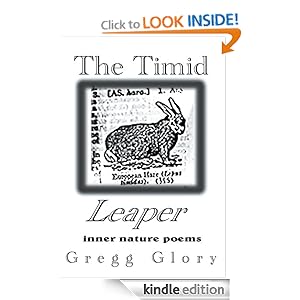
The Timid Leaper


List Price:
$18.95

Add to Cart

Authored by
Gregg G Brown, Gregg Glory

inner nature poems

From the Intro:

Catastrophes and Trophies

This collection is actually the combination and slight rearrangement of four separate volumes of verse; almost all of these poems were written in the calendar year 2001. It’s not much to show for a year of human life– that rich mystery we are twisted into by such a resolute hand. The main emphasis of this collection (as I hope will be quite clear) is Nature. Nature and Naturalism are not quite the same thing, however, and I have always had my own disagreements with the various proponents of those who took too dogmatically Thoreau’s painful premise “Simplify, simplify, simplify.” The sub-title is “inner nature poems,” and that is to help show that the weather for humans is never merely a matter of what’s over our heads– it’s what’s in our hearts as well.

Kindle Edition on Amazon ($3.99).

Publication Date:
June 25, 2002
ISBN/EAN13:
0595230970 / 978-0595230976
Page Count:
304
Binding Type:
US Trade Paper
Trim Size:
6" x 9"
Language:
English
Color:
Black and White
Related Categories:
Poetry / American / General
Sep 262011
 

The band played out a cheer-like rendition of “May Auld Acquaintance Ne’er Be Forgot” as the graduates’ caps reached their apogee–a thumbnail-sized fake gold ’86 as badass big as a rap star’s ring bling (but that’s skipping ahead; in 1986 LL Cool J was still “Rocking the Bells”) attached to each flying tassel twined in Monmouth College’s twin school colors lion yellow and royal blue. Chromed highlights from the flotilla of parents’ and their students’ cars were visible from the ceremonial stage over the graduates’ now bending backs as they pecked like feeding chickens at the ground retrieving their square caps and laughing at each other, so happy to be sweating and finally free of school duties. And not just for the summer, but for a lifetime!

Gilman worked his way over to the science building with a few of the other Eng Lit majors, their robes cresting the concrete steps in vivid morning glory blues. They didn’t actually say to much, except for DiEllio, who held forth on his learning Croatian for an upcoming trip to the hidden land of the Croats. Everybody agreed it sounded really cool. Here they were, room 106, ready to pick up their official sheepskins, the authenticating certificate of baccalaureate matriculation. The school had recently begun handing out blank scrolls at the podium as each student’s name was called to avoid awkward mix-ups with the paperwork. Nobody wanted Ellie Mandelbrot (communications major) to go thoughtlessly tearing off for a post-graduate kegger with Elias Mandelstam’s BS in Higher Mathematics (minor in physics). At the desk was their old prof, Dr. Leveller, who looked to be twisting a watch fob on his affectatious waistcoat.

“Well, here you are,” noted the old professor blandly. He seemed happy enough to get a final look-see at his handiwork. “You’re all here, alphabetically.” He riffled the stack of degrees like playing cards dispensed from a pinochle shoe in Atlantic City, epicenter of tax revenue earmarked for education. “Casinos for Colleges!” was the winning slogan used when the law was passed to allow gambling in the state again. Nowadays you can lose your house in a bad night, but you can’t take the edge off with a puff.

Gilman was last in line, content to feel the comfort of friends and the air-conditioning for a while before he had to go back outside and find his ride in the hot crowd.

“Nothing for you,” Dr. Leveller pronounced with a twee smile. “Seems you’ve fallen off the edge of the world, Gilman.” He opened his hands to show that they were empty, his right index digit slightly discolored by tobacco; Dr Leveller had been twisting the dottle out of a tiny pipe and not winding a watch fob earlier. Gilman was inclined to laugh at not getting his diploma, but didn’t want to stand out among his schoolmates–all of whom had already left the room. He managed an uncomfortable smile.

“Look, Gilman,” Dr Leveller began. “Just go down to the registrar’s office when summer classes begin and they’ll straighten it all out. Your name was mis-spelled on your diploma, so they sent it back. Mrs. Watson remembers you distinctly.”

Gilman looked blankly down at the doctor.

“Mrs. Watson is the registrar. She remembers you.

Gilman, not wanting to feel like a total doofus, nodded. “Kinda like in the Fairie Queen when the knight is all lost in that hairy swamp and gets a sign that he’ll stay lost for a good while longer.”

“Let’s hope this chapter comes to close more quickly,” Dr. Levller noted ironically, pushing his left mustache with a blunt fingertip, so light and blonde and small it would have be invisible were it not for Dr. Leveller’s habit of brushing it. “What will you be doing with your summer?” he asked idly, seeing that Gilman hadn’t moved from his spot and was still playing with the empty tube of his blank diploma, the gold ribbon keeping it neatly rolled in his nervous hands as he pushed his heavy glasses back up the bridge of his nose.

“Oh, an epic poem.”

“Really?” Dr. Leveller’s eyes looked with a quiet estimation at Gilman, thin and wiry as a clothes-hanger under his flowing robe blue as a Tahitian waterfall.

“Oh, yeah,” Gilman continued, a bit over-excited thinking about it. “I’ve got it all figured out.”

“I see,” Dr. Leveller replied, relaxing once again, and letting the heavy lab table, bristling with spotless test tubes for the next experiment, take the weight of his haunch. “Well, you’d best be going.”

“Oh, OK. Right.” Gilman took a slippery step toward the door, his dress shoe sliding over the waxed floor like an ice-skater’s blade.

“Remember your Milton,” he heard as the automatic door closed behind him with the rubber hiss and dead click of sealing a vault. Gilman ran to the stairs and decided at the last second to slide down the bannister ass-first, his robes clumping between his legs. He had always loved Lycidas, especially the ending.

Sep 262011
 

It is almost the ides of Octoberfest, and my mind is turning toward the furious fun of NaNoWriMo, National Novel-Writing Month, which is actually in November. But for some reason this year I just can’t wait. Last time out of the gate, I got down “The Singing Well,” a Young Adult coming-of-age novel that surprised me and still holds up pretty dran well. It’s available for purchase on CreateSpace. Read about it here.

I don’t have a title for the new one, which I just started a few hours ago, but I’ll be posting to it daily as “30 Days” in the Novellas section of gregglory.com/wordpress.

Off we go! The tale commences here.

Sep 142011
 
Last Tuesday, for kicks, the cachinnate sea-crew
Downed an albatross, a vast sea-bird,
The indolent companion of our wake, who lazily traced
Our ship's slippage through bitter breakers.

Once deposed to the common planks,
This king of the wild blue stumbled in shame,
Piteously dragging his white infinite wings
Like chalky oars unmoored beside him.

Winged voyager!  Now dementedly frail!
O royal one!  Now splay and exposed!
One sailor crams His Highness' beak with a burning pipe;
The next limps and mimics this cripple who soared!

The Poet is one with this swift prince of the clouds
Who haunts the tempest and mocks swart archers:
Exiled to earth's low hoots and threats,
His giant wings hobble each inch of his step.

--Charles Baudelaire


Sep 142011
 

Dear Reader:

Let me elaborate (without belaboring) my point in print. Let’s say one questions the status quo: Hey Quo, what’s up with that, yo? The question, by its very nature, throws doubt upon the validity and durance of the status quo, or things as they are. Maybe things should be arranged otherwise, maybe other arrangements or interpretations would be more penetrating and correct, or would open avenues of action that would be grander or more satisfying. Questions, in this respect, are like headlights that can help us sketch out the dimensions and "give" in the fog that surrounds us.

What questions, in and of themselves, cannot do in these circumstances is prove anything about the validity of the status quo one way or another. Because one can formulate a question about the status quo does not, in itself, undermine things as they are in any way. Hey Quo, are you sure that the ground is under my feet? This question does nothing to remove the ground from under your feet–it is simply a question–a question that can start a process of discovery that itself should be questioned and not simply assented to because it undermines current understanding. This is what I meant about "questioning the questions."

A question is simply the first step on a path that may eventually lead to the heady heights, and vast new perspectives, of disproof of the status quo; but the question is not the map, the donkey, the traveler, the sweat and the path all in one. The ground under your feet is solid until physics comes to eventually prove–through assertions and demonstrations (the sweat and donkey, etc.)–that in fact the ground is mostly made up of empty space between those tiny head-spinners, atoms.

Questions start the discovery, but the doubts are only worth paying attention to when evidence begins to solidify their guesswork with a bridge to a new reality, a new solidity. This goes on forever and ever, and even our views of bridges past begin to be swallowed up in the present fog and our next new journey can be to re-tread the paths of discoveries "past."

But then, what is Time, really?

Gregg Glory

Sep 142011
 
"The rat I wrangled from my womb has wronged me!
Bit me! Bled me!  Hear a mother's cry to kill her kid!
Choke the sopping monster who goes glued to Fate
By my very blood!  Sucked from my very teat,
	milk and blood both-- bitter, bitter!
O Aegiesthus' ghost-- where are you? 
	Hold my breasts and fuck me!
These same breasts that came with my pubescent blood,
Oresetes nuzzled-- his skull-top as soft as his pea of a nose.
Unfinished he flooded into a turgid world,
Torn by troubling dreams;  I built him from boy to man, I
And I alone touched him wonderingly, wantingly:
That this star should fall from my fuckholeÖ.
Damn him!  Damn him!  What is it to be a mom
If men may treat their mothers thus?  Curse him!
My identity's stripped to ifs without him;  without him
Numbered and known as my son, my son.
Hard the travail, hard the happiness, and now
	hard the death-time
Of mothers and their motherhood.
Sleepless across the groined earth I groan,
Loneliness airless and endless.  Not mother, but murderer
My son--that damned man--proclaims me to finally be.
His insistence on Justice is a sinkhole of sorrows
Burying his Mommy for God.  Ah, God--
No;  no refuge there;  no clouds, no angels, no respite
For a woman torn and scorned.  I'm jammed into my gender:
First, pollution of the menstrual punch, then sex
Wished-for in waiting, not sought in warm arousal
But closeted and kept close, moldy with hoping--
Thin mystery of the singing clit mixed with sorrow-oh!
Known then as Agamemnon's woman, addendum to majesty,
That which cleaves and is cloven--flickeringly split in loving--
His arms the margins of my seacoast--no more, no less.
And no woman knows another; slakers and takers of the defining phallus--
Competitive finessers of the clamping circumstance.
Came Helen, and away went our hairy thousands,
All the wood echoing like a troubled drum.
Men marching into the sea!  Seaborne, sea-torn,
So many with no fluff on their chins, little wrigglers.
War-widow I was then, alone as a lion,
Stalking the beaches at dawn, clubbed and stunned
By the night menaces;  the sins of the dreamless hours,
My mind a shifty shuttle on no holy loom.
What was I in this absence of passions?  Unkicked, unlicked.
No nobility rolled, lucid and lovely, from my hurt hollows.
I was uncoiled and void;  knowingless, dirty, and numb."


Sep 142011
 
An old-time, small-town hardcore "con"
polite enough to jigger mint juleps in tinking silver cups
rubbed smooth by lips ribbed smooth
with talking.  Politics, aesthetics, jeremiads,
history's candid tangle of catastrophes
--any subject that nights ripen and split
enough to show the sense of meaning 
at the snapping seams;  thought stretched taut
until articulation sang.  O the million nights
chattered ruefully through to human truth!
Rhythm's doubled thrubs send the heart-beacon out
beneath the boards, like your troubled and beloved Poe
moaning lonely for his Annabelle Lee, lovely
ideal resurrected from the dead real.

Your life-plot's coiled as Rosencrantz',
a labyrinthine mind of steel and twine
following each God-doled bread-crumb clue
to God's appointed apotheosis;
intent as a atheist pimping out a principle.
You loiter with stories forever unfinished,
once started, not knowing "how way leads on to way."
Each enunciated principle's broadened
with tributary amendments, altering
precursor and course upon reconsideration;
Rabelaisian babble nipped and tucked tidy
by a laser-guided philosophy.

Long ago in your yeoman youth you started
dreaming past the dragon's hiss, the dragon's tooth,
to inner virtue's unvarying, vibrant truth.
Now an earnest father gone haggard at the world's lies--
you sit a spastic Little Hamnu down to talk--
and finish grinning and whistling in the dark,
stuck, like Coleridge with his quaint Constancy,
or an aim-awry Orion facing West,
stark as a marker in the stars' fixed rigging.


Sep 022011


List Price:
$3.75

Purchase from CreateSpace

Purchase from Amazon

Sipping Beer in the Shadow of God

Travel Notes and Prose Poems in the spirit of Basho

Authored by
Gregg G Brown

JOHN MUIR’S AUGUST HEAD

John Muir’s queer and sundry quotations and exclamations shine through pane after pane of Yosemite Valley’s buildings. Less a ghost and more of a sacred mascot, his bearded visage seems to hang down from every shaggy tree and to impose itself in the crinkled cliff-shadows on every side of this immense religious fosse into which tourists pour as amply as blood or wine. “How glorious a greeting the sun gives the mountain!” “I never saw a discontented tree.” “The mountains are calling, and I must go.”

Kindle Edition on Amazon ($0.99).

Publication Date:
Aug 15 2011
ISBN/EAN13:
1466231157 / 9781466231153
Page Count:
70
Binding Type:
US Trade Paper
Trim Size:
5.5″ x 8.5″
Language:
English
Color:
Black and White
Related Categories:
Poetry / American / General
Sep 022011


List Price:
$16.75

Add to Cart

Authored by
Gregg G Brown

Collected poems of Gregg Glory [Gregg G. Brown]

Questioning Is Questing

Western civilization is in a cul-de-sac. At the end of that cul-de-sac is a guillotine. Beside that guillotine stands the hulking executioner in his greasy black hood. Through that hood peer two red, maddened eyes. Below those eyes, as through a lazy tear, shows a long, slavering wolf-thin grin. Lightning stitches knots in the dead, leaden skies. Thunder interrupts the prayers for the dead. Doom. DOOM. DOOM.

Even so, my life is filled with primroses and wishes. I sit here–or lie, rather, languid as an American Oblamov rolled in his snoozy comforter– building my empire of words.

I’ve spent long, sad years loving people I never could come to know. Strangers whose alien minds lived other lives, pattering after petty pursuits I never really could come to understand. Now I fear that my own kindness and lack of company has led me, in an easy dream of desperation, to see Helen in every barmaid’s face.

Cold are the coals I have gathered, betrayed by a generous impulse that led me to love first and question second. Over evil rapids I have roved, slouching to the salt dissolution of the sea, who should have been climbing heavenward with Manfred–my eye upon some solitary cloud-wracked peak where every subtle shifting shape suggests a new, unborn greatness (or an old noble greatness renewed) to the seeker’s keen and lonely imagination. Instead, I have sunk my mind among warm elbows at a crowded table, seeking fellowship in banal company and dissipating what genius drifts to me in shrunken rounds of tavern talk. Few have been the companions time has tested true. I recall my Mom, downed in her home hospital bed and not the bed of her marriage, pointing at my nose with a red, imperious finger, demanding first and foremost (loved son or no) that I “tell it true.”

To that improbable pipsqueak queen, crippled yet proud as the devil in her flowered hospital gown–and to her regal charge–I keep my pledge.

I do not condemn others for my misjudgments, but, looking at the litter of years, I begin to perceive that there was something of method in my mismeasure. Questioning is questing. Leaving a question open encourages all comers to the query to have the experience of exploration; each hypothesis is happy to go unconfirmed, as long as the hypotenuse is mutually traveled by writer and reader in the coracle of a quatrain. There is something of Emerson in this energy of questioning, but none of his faith in God’s final ground, the rock of reality.

May such dubious wisdom as my pain has gathered serve me well henceforward. May the narrowing of possibilities sharpen my focus, as when a saltine’s pinhole, brought close to the eye, removes the blur of distant things, clarifying every tiny difference and shutting out peripheral static.

It is only now, as this labor of years surrounds me on every desktop, that I am coming to feel that the best strength of my youth has been wasted elaborating a maze of quizzes instead of attempting to soar, however falteringly, into the omniscient sun. Was it a deficit of pride that had me prefer puzzles to plumage? Or some more insidious hidden desire to be touted and touched instead of respected and feared? Well, here I am again, ending each sentence with my shepherd’s crook (?) instead of the thunder god’s triumphant stab and pang! So much of our humanity is mist and mystery; so many of our hours slide by in incapable ignorance. But what makes our lives worth the sinning that created them is the moment the mirror comes clear, as if in a revelation, and every face confronts the tragedy of its character.

Kindle Edition on Amazon ($0.99).

Publication Date:
Sep 02 2011
ISBN/EAN13:
1466275731 / 9781466275737
Page Count:
766
Binding Type:
US Trade Paper
Trim Size:
6″ x 9″
Language:
English
Color:
Black and White with Bleed
Related Categories:
Poetry / American / General
Sep 022011
 
Oh, Little Wilfred dutifully read 
the Bible with his Mum and walked 
with verse effervescing in his head.

~~Owen in England, Daniel J. Weeks

Take a psalm, and bring hither the timbrel, the pleasant harp with the psaltry. Blow up the trumpet in the new moon, in the time appointed, on our solemn feast day.
~~Psalm 81

Introduction

Like a father pruning the limbs of his children, I have looked over my creations with a lenient eye. The worst verse has been relegated to the back of the book and is fit only for prurient scholars’ noses. If you wish, this last section of my collected works may simply be lopped off with a kitchen knife. But then, alas, you would lose the redoubtable “triple index,” which includes not only the Titles and First Lines of each of the poems, but the memorable cannon-shot of their final, triumphant line as well. This fixes a deficiency I feel in every big volume of verse my thumb has troubled to fiffle across.

I had long harbored a desire to collect the refuse of my muse, the afterburn of endless nights of wild inspiration, in a volume of collected poems. As the mirror disclosed a forehead growing more and more Shakespearean with the incrementing eons, the tagalong shadow of my desuetude became increasingly intolerable. Mortality would soon collect me and leave my litter of poems to a sadly disordered fate. I must act!

~~Gregg Glory 2010

Questioning Is Questing

Poetry is my Kingdom, Phylum, and Species

Western civilization is in a cul-de-sac. At the end of that cul-de-sac is a guillotine. Beside that guillotine stands the hulking executioner in his greasy black hood. Through that hood peer two red, maddened eyes. Below those eyes, as through a lazy tear, shows a long, slavering wolf-thin grin. Lightning stitches knots in the dead, leaden skies. Thunder interrupts the prayers for the dead. Doom. DOOM. DOOM.

Even so, my life is filled with primroses and wishes. I sit here—or lie, rather, languid as an American Oblamov rolled in his snoozy comforter— building my empire of words.

I’ve spent long, sad years loving people I never could come to know. Strangers whose alien minds lived other lives, pattering after petty pursuits I never really could come to understand. Now I fear that my own kindness and lack of company has led me, in an easy dream of desperation, to see Helen in every barmaid’s face.

Cold are the coals I have gathered, betrayed by a generous impulse that led me to love first and question second. Over evil rapids I have roved, slouching to the salt dissolution of the sea, who should have been climbing heavenward with Manfred—my eye upon some solitary cloud-wracked peak where every subtle shifting shape suggests a new, unborn greatness (or an old noble greatness renewed) to the seeker’s keen and lonely imagination. Instead, I have sunk my mind among warm elbows at a crowded table, seeking fellowship in banal company and dissipating what genius drifts to me in shrunken rounds of tavern talk. Few have been the companions time has tested true. I recall my Mom, downed in her home hospital bed and not the bed of her marriage, pointing at my nose with a red, imperious finger, demanding first and foremost (loved son or no) that I “tell it true.”

To that improbable pipsqueak queen, crippled yet proud as the devil in her flowered hospital gown—and to her regal charge–I keep my pledge.

I do not condemn others for my misjudgments, but, looking at the litter of years, I begin to perceive that there was something of method in my mismeasure. Questioning is questing. Leaving a question open encourages all comers to the query to have the experience of exploration; each hypothesis is happy to go unconfirmed, as long as the hypotenuse is mutually traveled by writer and reader in the coracle of a quatrain. There is something of Emerson in this energy of questioning, but none of his faith in God’s final ground, the rock of reality.

Lewis and Clark stood equally on the grass banks overlooking the Missouri. Who could say with assurance, seeing them leaning into the wind with their hands shading their eyes, which of the equal pair could see the coming settlements most clearly? Who invoked a vision, and who merely scratched a map? It is only now, with time, that I recognize that there is a necessity underpinning every river’s haphazarding. That, somehow, only a drunken Lewis who shot out his heart in dread despair could have whispered the new world aright into an impatient Jefferson’s ear.

May such dubious wisdom as my pain has gathered serve me well henceforward. May the narrowing of possibilities sharpen my focus, as when a saltine’s pinhole, brought close to the eye, removes the blur of distant things, clarifying every tiny difference and shutting out peripheral static.

In the poems that follow, however, it is the sharing of experience, the open stance of questioning without conclusion, that is most in evidence. And, in the extreme case of “Rehearsing Repetitions on the Rappahannock,” a meditative stance—at once open, aware, and inconclusive, is instantiated without the rhetorical crutch of a question mark.

My old compatriot in the arts, Lord Dermond, fondly dubbed me “the questioning poet,” and steadfastly refused to call me anything else. At the time, and still perhaps, since I myself am no settled question, I took delight in the name, seeing all things as things in flux, and enjoying the jouncing ride of the rapids, the variegation and contrast of the speeding banks. Dan Weeks, assembling a selected works of mine some years ago titled “The Death of Satan” also came to find merit in my querulous habit of mind.

It is only now, as this labor of years surrounds me on every desktop, that I am coming to feel that the best strength of my youth has been wasted elaborating a maze of quizzes instead of attempting to soar, however falteringly, into the omniscient sun. Was it a deficit of pride that had me prefer puzzles to plumage? Or some more insidious hidden desire to be touted and touched instead of respected and feared? Well, here I am again, ending each sentence with my shepherd’s crook (?) instead of the thunder god’s triumphant stab and pang! So much of our humanity is mist and mystery; so many of our hours slide by in incapable ignorance. But what makes our lives worth the sinning that created them is the moment the mirror comes clear, as if in a revelation, and every face confronts the tragedy of its character.

Miles to Go

This poem has no details 
If you won't carry water 
100 miles in your hands.

Break through the skim of ice 
In December, right behind that silent glass factory 
All one tall shadow on the Raritan.

Watch your hands shiver. 
Feel your wet cuffs the first 20 miles 
Until the sky is a shard in your palms,

And you fret about cutting your wrists 
Accidentally.


Why the Title?

Well, my original idea for the title was “Welcome to Mt. Olympus.” This warm, generous, applauding pat-on-the-back hand-up welcome to my potential audience reflects well my open nature: I’m a born patsy. My book of verse plays is called “A Million Shakespeares” in the same spirit. It has always been my conviction that there’s a spark of greatness in each of us—waiting only for a willing wind or closely blown kiss to fan that spark to flame. My friend and fellow-poet Dan Weeks had an instructor at Washington and Lee who was always gesturing to his class to “Join me up here on Mt. Olympus, people!” And I share that spirit of invitation and incitement. In a humorous mood, the title’s blandishment reminded me of postcards, bent and abandoned in their twirling black wire racks. And, as I frequented rock clubs in Asbury Park for several eons beyond my youth, postcards made me think of Bruce Springsteen’s famous debut album cover; a simple postcard with the words “Greetings from Asbury Park.” Inside each letter is a montage of vistas and perspectives, snipped snapshots. I certainly hope my words are so amply packed.

Finally, my mind wandered to Wallace Stevens’ (whose book I uncomprehendingly purchased with several weeks of paper-route pay as a 16- year old, and God know why) “Postcards from the Volcano”—a jewel of meditation on inter-generational sharing. Well, now you know something of how my knobbed and hobbled mind spins its dials and generates the green lightning of its associations, touching together black earth and blank sky. I hope it is just roadmap enough to encourage and ward your roads’ wandering more, well, let’s say more, rewardingly.

….. Here’s a million words. If only they were nickels, I’d be rich!